Introduction
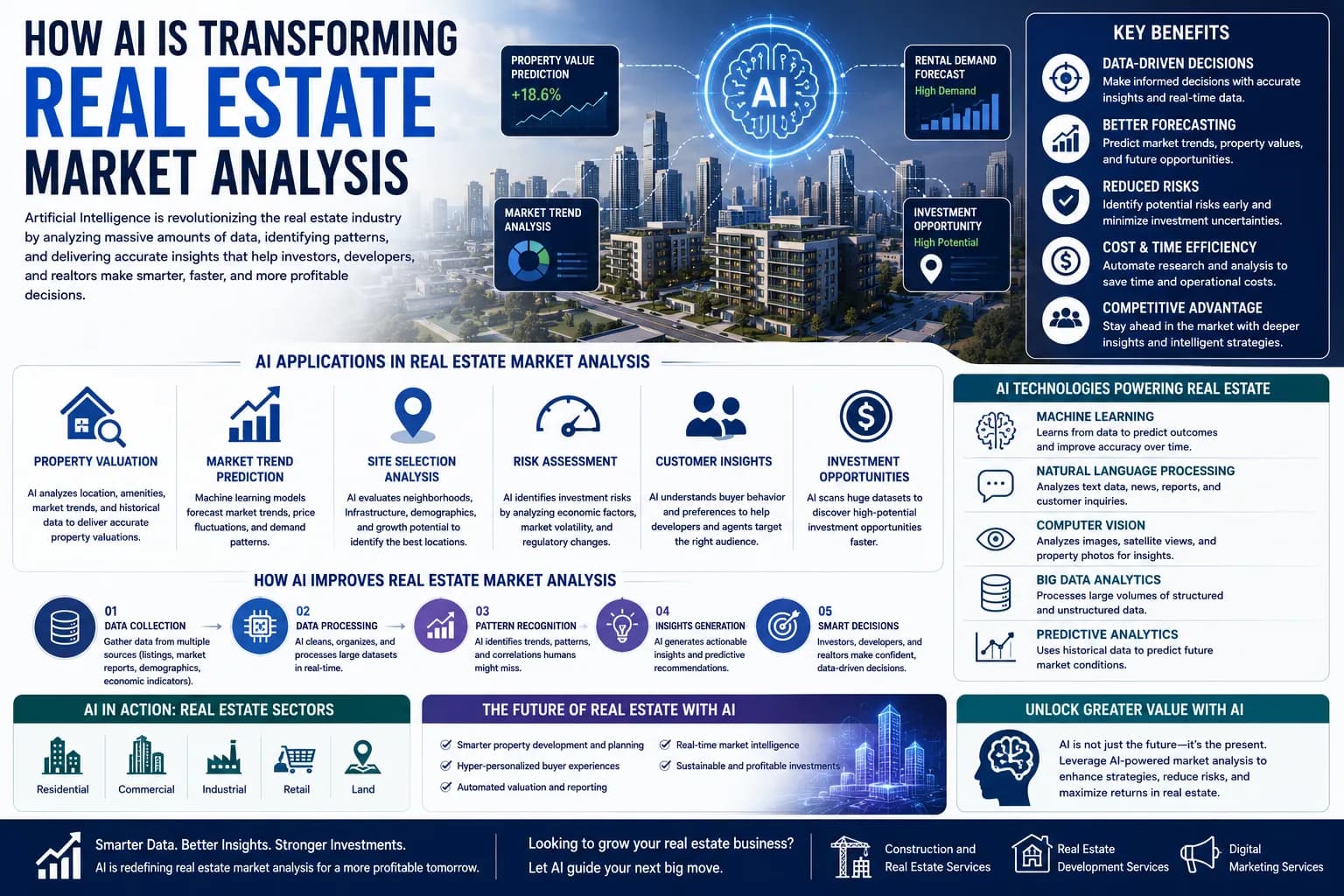
The real estate industry has always relied on market research, property valuations, demographic trends, and economic indicators to make informed decisions. However, traditional methods often require significant time, resources, and manual analysis. In 2026, Artificial Intelligence (AI) is transforming the way investors, developers, brokers, and property managers analyze real estate markets.
AI-powered tools can process vast amounts of data within seconds, identify hidden trends, predict market movements, and provide highly accurate insights. Organizations involved in Construction and Real Estate Services are increasingly leveraging AI technologies to improve decision-making, reduce risks, and maximize returns on investment.
From identifying profitable locations for real estate development services to forecasting future property values, AI is becoming an indispensable asset for modern real estate professionals. Combined with strategic Digital Marketing Services, AI also helps businesses attract qualified buyers and investors more effectively.
This guide explores how AI is reshaping real estate market analysis and why it is becoming a critical competitive advantage in 2026.
What Is AI-Powered Real Estate Market Analysis?
AI-powered market analysis uses machine learning algorithms, predictive analytics, big data, and automation tools to evaluate real estate market conditions.
Unlike traditional analysis methods, AI can process data from multiple sources, including:
Property listings
Historical sales records
Economic reports
Demographic statistics
Social media trends
Geographic information systems (GIS)
Consumer behavior data
This allows real estate professionals to make faster and more accurate decisions.
Why AI Matters in Real Estate
The real estate market generates enormous amounts of data daily.
Challenges of Traditional Analysis
Time-consuming research
Limited forecasting accuracy
Human bias
Difficulty processing large datasets
Delayed decision-making
AI helps overcome these challenges by delivering real-time insights and predictive intelligence.
Benefits of AI
Faster analysis
Improved accuracy
Better risk assessment
Enhanced forecasting
Data-driven investment decisions
These advantages are transforming the entire industry.
AI-Powered Property Valuation
One of the most important applications of AI is automated property valuation.
How It Works
AI analyzes factors such as:
Location
Property size
Amenities
Market demand
Historical sales data
Neighborhood growth
The system then generates accurate property valuations within seconds.
Benefits
Faster appraisals
Reduced human error
Consistent evaluations
Improved pricing strategies
This helps investors and developers make informed decisions.
Predicting Real Estate Market Trends
AI excels at identifying patterns that humans may overlook.
AI Forecasting Capabilities
Property value appreciation
Rental demand
Population growth
Market cycles
Economic influences
By predicting future market conditions, businesses involved in real estate development services can make smarter investment decisions.
Site Selection and Development Planning
Choosing the right location is critical for successful property development.
AI helps developers evaluate:
Key Factors
Population density
Infrastructure availability
Traffic patterns
Economic activity
Future growth potential
Local regulations
Organizations providing Construction and Real Estate Services can use AI-driven insights to identify high-potential development opportunities.
Risk Assessment and Investment Analysis
Every real estate project involves risk.
AI can assess:
Financial Risks
Market volatility
Interest rate changes
Economic downturns
Development Risks
Construction delays
Cost overruns
Regulatory challenges
Market Risks
Oversupply
Declining demand
Changing demographics
Advanced risk analysis helps investors minimize losses and improve profitability.
AI and Big Data in Real Estate
Modern real estate analysis depends heavily on data.
AI processes information from:
Public records
Property databases
Government statistics
Satellite imagery
Consumer trends
Economic indicators
Benefits
Real-time market insights
Improved forecasting accuracy
Better investment planning
Enhanced competitive analysis
Big data and AI together provide a powerful foundation for decision-making.
Understanding Buyer and Tenant Behavior
Consumer preferences play a major role in real estate success.
AI analyzes behavioral patterns to understand:
Buyer Preferences
Desired locations
Property types
Budget ranges
Lifestyle priorities
Tenant Needs
Rental affordability
Amenities
Commute preferences
Community features
These insights help developers design properties that meet market demand.
AI in Commercial Real Estate Analysis
Commercial property investments require extensive market evaluation.
AI assists by analyzing:
Office occupancy trends
Retail performance
Industrial property demand
Business activity levels
Local economic growth
This information helps investors identify profitable opportunities.
AI for Residential Property Markets
Residential developers use AI to forecast housing demand and identify emerging neighborhoods.
Applications
Housing affordability analysis
Family demographic trends
Migration patterns
School district evaluations
Community growth forecasts
These insights support successful residential development strategies.
AI and Smart Construction Planning
AI is not limited to market analysis—it also improves construction planning.
Smart Construction Benefits
Better resource allocation
Cost forecasting
Timeline optimization
Risk management
Quality control
Companies offering Construction and Real Estate Services are increasingly integrating AI throughout project lifecycles.
Role of Digital Marketing Services in AI-Driven Real Estate
Once a property project is developed, attracting buyers and investors becomes essential.
Professional Digital Marketing Services use AI to:
Improve Lead Generation
Identify and target qualified prospects.
Personalize Marketing Campaigns
Deliver customized content based on user behavior.
Optimize Advertising
Improve campaign performance and ROI.
Analyze Customer Data
Understand buyer preferences and engagement patterns.
AI-powered marketing helps real estate businesses generate higher-quality leads and accelerate sales.
AI Chatbots for Real Estate Businesses
AI chatbots provide instant support to potential buyers and tenants.
Common Functions
Property recommendations
Appointment scheduling
Lead qualification
Customer support
Virtual property assistance
Chatbots improve customer experiences while reducing operational costs.
Predictive Analytics for Investment Opportunities
Predictive analytics is one of AI's most valuable capabilities.
AI Can Predict
Emerging investment hotspots
Future rental demand
Property appreciation potential
Economic growth areas
Investors can identify opportunities before competitors enter the market.
Challenges of AI Adoption in Real Estate
Despite its advantages, AI implementation comes with challenges.
Common Challenges
Data Quality
Accurate insights require reliable data.
Technology Costs
Advanced AI systems require investment.
Staff Training
Teams must learn how to interpret AI-generated insights.
Privacy Concerns
Data protection and compliance remain critical priorities.
Proper planning helps organizations overcome these obstacles.
Future Trends in AI and Real Estate
Several innovations are expected to shape the future of AI-driven market analysis.
Advanced Predictive Modeling
More accurate long-term forecasts.
Digital Twin Technology
Virtual property simulations for planning and management.
Automated Investment Platforms
AI-assisted investment decision-making.
Smart Cities Integration
Connected urban infrastructure generating real-time market data.
Generative AI
Enhanced reporting and market research capabilities.
These advancements will further improve decision-making and profitability.
Best Practices for Implementing AI in Real Estate
Invest in Quality Data
Reliable data improves AI accuracy.
Start with Specific Objectives
Define clear business goals.
Integrate AI Across Operations
Use AI for research, development, sales, and marketing.
Combine Human Expertise with AI
Technology should enhance—not replace—professional judgment.
Monitor Performance Continuously
Refine strategies using real-time insights.
Conclusion
Artificial Intelligence is transforming real estate market analysis in 2026 by providing faster, smarter, and more accurate insights. From property valuation and market forecasting to investment planning and customer targeting, AI enables organizations to make data-driven decisions with greater confidence.
Businesses involved in Construction and Real Estate Services are increasingly using AI to identify opportunities, reduce risks, and improve project outcomes. Likewise, organizations offering real estate development services are leveraging predictive analytics to optimize site selection, planning, and investment strategies.
When combined with strategic Digital Marketing Services, AI becomes an even more powerful tool for attracting buyers, generating leads, and maximizing returns.
DoddapaneniGroup.net provides innovative construction, real estate, AI, software development, and digital transformation solutions that help businesses thrive in a rapidly evolving marketplace.
Disclaimer: This content is for informational purposes only and should not be considered financial, legal, or investment advice.