Introduction
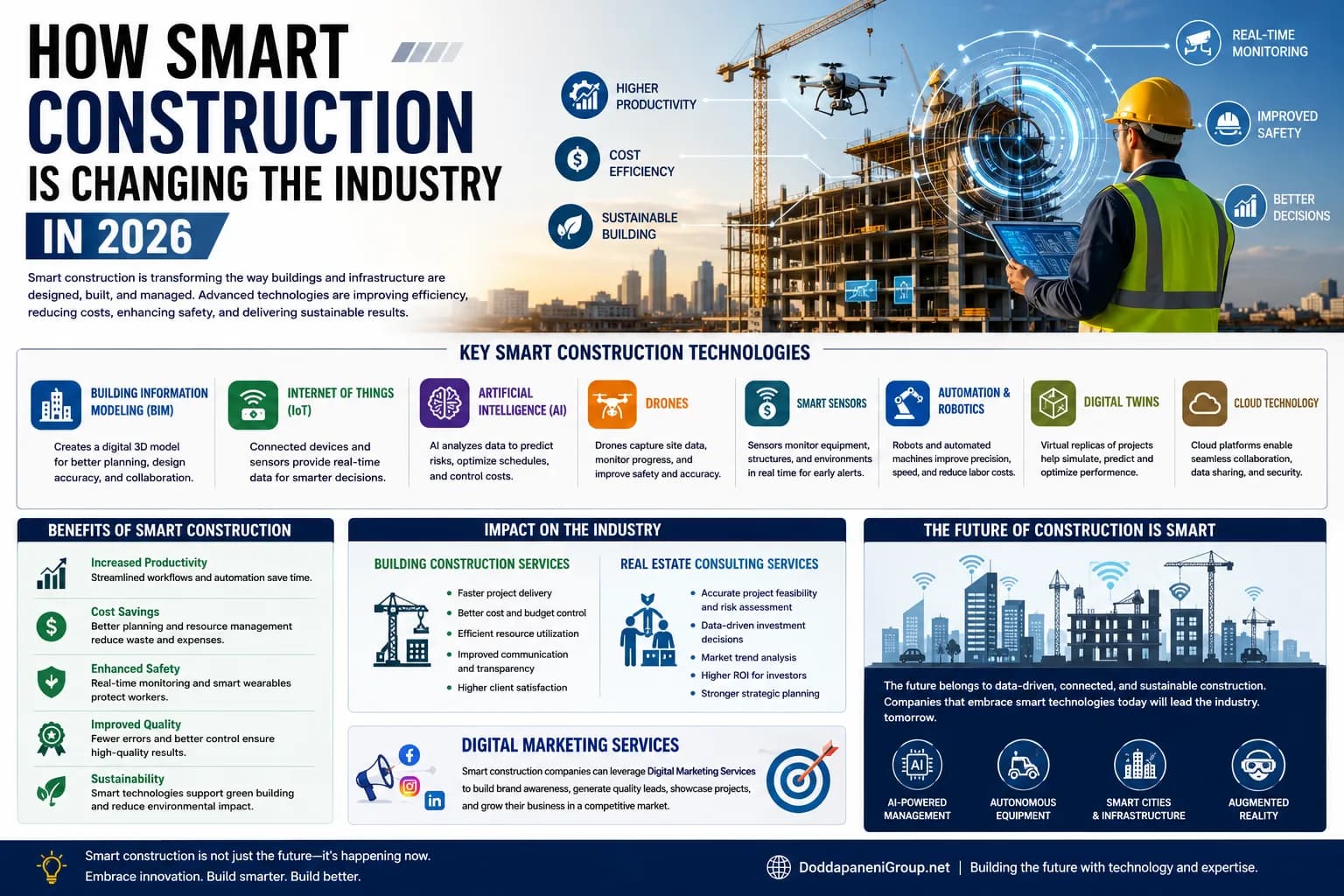
The construction industry is undergoing a major transformation in 2026. Traditional construction methods are rapidly being replaced by intelligent technologies that improve efficiency, reduce costs, enhance safety, and accelerate project completion. This shift is known as Smart Construction.
From artificial intelligence and Building Information Modeling (BIM) to IoT-enabled equipment and drone surveying, smart construction technologies are helping companies streamline operations and make data-driven decisions throughout the project lifecycle.
Organizations offering building construction services are increasingly investing in advanced technologies to improve project management, resource utilization, and sustainability. Likewise, companies providing real estate consulting services are leveraging digital tools to evaluate projects more accurately and provide valuable insights to investors and developers.
This comprehensive guide explores how smart construction is reshaping the industry, the technologies driving innovation, and the benefits businesses can expect in 2026 and beyond.
What Is Smart Construction?
Smart Construction refers to the integration of advanced digital technologies into construction planning, execution, monitoring, and maintenance.
These technologies help construction professionals:
Improve productivity
Reduce project delays
Minimize waste
Increase worker safety
Enhance project visibility
Improve decision-making
Smart construction combines data, automation, and connectivity to create more efficient building processes.
Why Smart Construction Is Growing Rapidly
Several factors are driving the adoption of smart construction technologies.
Key Drivers Include:
Rising construction costs
Skilled labor shortages
Increasing project complexity
Demand for sustainable buildings
Need for faster project delivery
Growing technology availability
Companies that adopt smart construction solutions gain a competitive advantage in an increasingly demanding marketplace.
Building Information Modeling (BIM)
One of the most significant innovations in smart construction is Building Information Modeling (BIM).
BIM creates detailed digital representations of buildings before construction begins.
Benefits of BIM
Improved project visualization
Better collaboration among teams
Reduced design conflicts
Accurate cost estimation
Enhanced project planning
Organizations delivering building construction services use BIM to reduce costly mistakes and improve project outcomes.
Internet of Things (IoT) in Construction
IoT technology allows construction equipment, machinery, and devices to communicate in real time.
Common IoT Applications
Equipment monitoring
Worker safety tracking
Environmental monitoring
Asset management
Predictive maintenance
IoT systems provide valuable insights that improve operational efficiency and safety.
Artificial Intelligence in Construction
Artificial Intelligence is transforming construction management by analyzing vast amounts of project data.
AI Applications Include
Project scheduling
Risk assessment
Cost forecasting
Resource allocation
Quality control
AI-powered tools help project managers make more informed decisions and reduce delays.
Construction Drones Revolutionizing Site Management
Drones have become essential tools on modern construction sites.
Drone Uses Include
Land surveying
Site inspections
Progress monitoring
Safety assessments
Aerial mapping
Benefits
Faster data collection
Reduced survey costs
Improved accuracy
Enhanced safety
Drone technology allows project managers to monitor construction activities more efficiently.
Smart Sensors and Real-Time Monitoring
Smart sensors provide continuous data about construction projects.
Sensors Can Monitor
Structural integrity
Temperature
Humidity
Equipment performance
Worker movement
Real-time monitoring improves project quality and reduces risks.
Automation and Robotics in Construction
Automation is reducing dependence on manual labor while increasing productivity.
Examples Include
Robotic bricklaying
Automated excavation
Concrete printing
Autonomous construction equipment
Benefits
Faster construction
Lower labor costs
Improved precision
Reduced workplace accidents
Robotics is expected to play an even larger role in future construction projects.
Digital Twins in Construction
Digital twin technology creates virtual replicas of physical buildings and infrastructure.
Benefits Include
Real-time performance tracking
Predictive maintenance
Improved facility management
Better project planning
Digital twins help developers optimize building performance throughout the asset lifecycle.
Sustainable Smart Construction
Sustainability has become a major focus for modern construction projects.
Smart construction technologies support:
Energy-efficient buildings
Reduced material waste
Lower carbon emissions
Sustainable resource management
Green building initiatives are becoming standard across the industry.
How Smart Construction Improves Building Construction Services
Companies offering building construction services benefit significantly from smart technologies.
Key Advantages
Increased Productivity
Automation and digital workflows improve project efficiency.
Better Cost Management
Real-time data helps control budgets and reduce unexpected expenses.
Enhanced Safety
Smart monitoring systems identify potential hazards before accidents occur.
Improved Quality
Digital tools reduce errors and improve construction precision.
Faster Project Delivery
Technology-driven processes accelerate construction timelines.
Role of Real Estate Consulting Services in Smart Construction
Modern real estate consulting services increasingly depend on technology-driven insights.
Consultants Use Smart Construction Data For
Investment analysis
Project feasibility studies
Cost forecasting
Risk assessment
Market evaluation
Smart construction technologies provide consultants with more accurate information for strategic decision-making.
Cloud Technology and Construction Management
Cloud-based platforms are transforming how construction teams collaborate.
Benefits of Cloud Systems
Real-time communication
Centralized document management
Remote project access
Improved collaboration
Enhanced data security
Cloud technology supports seamless project coordination across multiple locations.
Predictive Analytics in Construction
Predictive analytics uses historical and real-time data to forecast future outcomes.
Applications Include
Budget forecasting
Schedule prediction
Risk management
Resource planning
Predictive insights help construction companies avoid costly mistakes and improve project success rates.
Workforce Safety Through Smart Technologies
Construction remains one of the highest-risk industries.
Smart technologies improve worker safety through:
Wearable safety devices
Real-time location tracking
Hazard detection systems
Automated alerts
Enhanced safety measures reduce injuries and improve compliance.
Challenges of Smart Construction Adoption
Despite its advantages, smart construction adoption can present challenges.
Common Challenges
Initial technology investment
Employee training requirements
Data security concerns
System integration complexity
Resistance to change
Proper planning and implementation strategies are essential for success.
Digital Marketing Services for Construction Companies
As construction companies embrace innovation, they must also promote their services effectively.
Modern Digital Marketing Services help construction businesses:
Improve online visibility
Generate qualified leads
Showcase completed projects
Attract investors
Build brand credibility
Digital marketing complements smart construction by helping businesses reach wider audiences and grow their market presence.
Future Trends in Smart Construction
Several emerging technologies will continue shaping the industry.
Future Innovations Include
AI-Powered Project Management
More advanced AI systems will automate decision-making and scheduling.
Autonomous Construction Equipment
Self-operating machinery will become increasingly common.
Advanced Robotics
Construction robots will perform more specialized tasks.
Smart Cities
Connected infrastructure will drive demand for intelligent construction solutions.
Augmented Reality
AR technology will enhance project visualization and workforce training.
Best Practices for Smart Construction Success
Invest in Scalable Technology
Choose solutions that can grow with business needs.
Train Employees
Ensure teams understand how to use new technologies effectively.
Prioritize Cybersecurity
Protect construction data and connected systems.
Use Data-Driven Decision-Making
Leverage analytics for better planning and project management.
Collaborate Across Teams
Technology works best when all stakeholders are aligned.
Conclusion
Smart construction is transforming the industry by combining digital technologies, automation, and real-time data to improve project outcomes. Companies providing building construction services are using smart tools to increase productivity, enhance safety, reduce costs, and deliver projects faster than ever before.
At the same time, technology-driven real estate consulting services are helping developers and investors make smarter decisions based on accurate project insights and predictive analytics.
As the construction industry continues to evolve, businesses that embrace innovation and leverage modern Digital Marketing Services will be better positioned to compete, grow, and succeed in the digital era.
DoddapaneniGroup.net provides innovative construction, real estate, software, AI, and digital transformation solutions designed to help businesses thrive in the future of smart construction.
Disclaimer: This content is for informational purposes only.