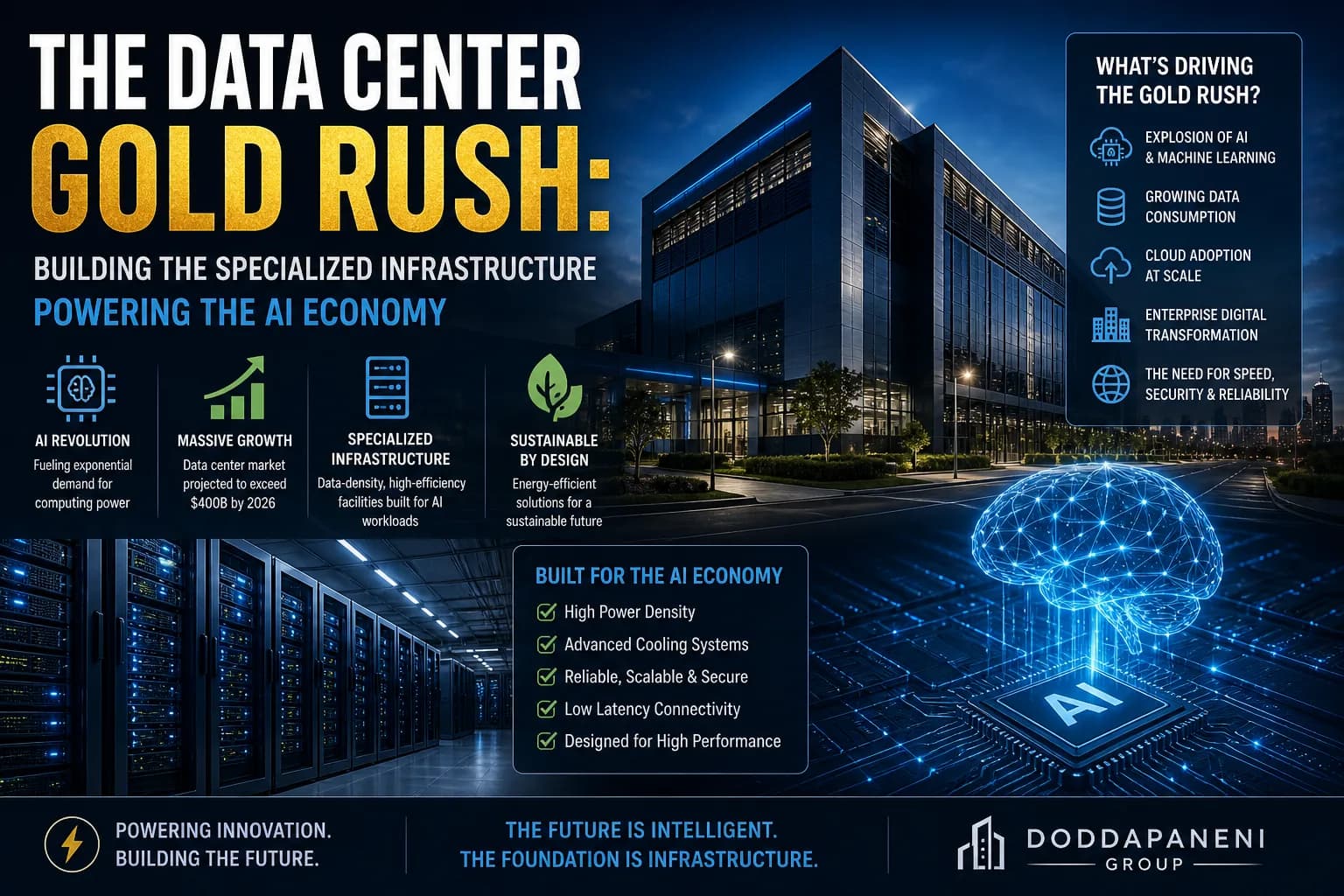
The Shift from Space to Power: A New Real Estate Paradigm
In traditional real estate development, the three most important factors were "location, location, location." In 2026, those have been replaced by "power, power, power." The value of a property is no longer determined solely by its proximity to a city center, but by its proximity to high-voltage utility interconnections and fiber-optic backbones.
As AI workloads become more intensive, the technical requirements for these facilities have skyrocketed. We are seeing a move away from standard 5–10 kW racks to high-density environments exceeding 50 kW or even 100 kW per rack. This shift has forced Construction and Real Estate Services to rethink everything from structural load-bearing capacities to the way we cool the massive heat loads generated by next-generation silicon.
1. Industrialized Construction and the Need for Speed
The race to provide compute capacity means that "time-to-market" is the most critical metric for any developer. To meet this, the industry has turned to industrialized construction methods:
Modular Assembly: Building "plug-and-play" power rooms and cooling modules off-site in controlled environments reduces on-site labor and compresses delivery timelines by 30% or more.
Prefabricated Facades: Using metal sandwich panels and high-performance cladding allows for rapid building enclosure, protecting sensitive equipment from the elements much earlier in the construction cycle.
Digital Twins: Every modern data center is now built twice—once in a virtual 3D environment and once on the ground. This ensures that complex MEP (Mechanical, Electrical, and Plumbing) coordination happens before a single bolt is turned.
2. The Power-First Strategy in Real Estate Development
With global power grids under immense strain, real estate development firms are no longer just land acquirers; they are becoming energy partners. The trend in 2026 is "on-site generation."
Microgrids and SMRs: We are seeing the first wave of data centers integrated with Small Modular Reactors (SMRs) and massive battery energy storage systems (BESS) to ensure 100% uptime without relying solely on a volatile grid.
Brownfield Retrofitting: Rather than starting from scratch, developers are snapping up old industrial sites and office buildings—projects known as "Adaptive Reuse"—to take advantage of existing permits and power allocations.
3. Cooling the AI Beast: Infrastructure Innovation
Traditional air cooling is reaching its physical limits. In 2026, Construction and Real Estate Services are increasingly specialized in liquid cooling infrastructure. This includes:
Rear-Door Heat Exchangers: A standard for moderate-density AI clusters.
Direct-to-Chip Liquid Cooling: Requiring precise plumbing and leak-detection systems integrated into the very fabric of the build.
Immersion Cooling: Where servers are submerged in dielectric fluid, demanding unique floor-loading solutions and specialized ventilation to handle the weight and fluid management.
4. Sustainability and "Heat Islands"
The scale of the AI build-out has brought environmental scrutiny. Modern real estate development now focuses on "Circular Energy." Leading developers are designing facilities that capture waste heat from servers and pipe it into local district heating systems or greenhouses. This turns a liability—excess heat—into a community asset, helping to secure "Social License to Operate" in regions where water and energy resources are tight.
5. Financial Resilience in a Capital-Intensive Sector
Building for the AI economy is not cheap. The average cost per megawatt (MW) has climbed to roughly $11.3 million in 2026 due to the specialized nature of the equipment and the scarcity of skilled labor. Consequently, we are seeing new financial models, including Real Estate Tokenization, which allows a broader range of investors to fund these massive infrastructure projects, and "Build-to-Suit" leases for hyperscalers like Amazon and Google.
The Future of the Digital Skyline
As we move further into 2026, the distinction between "real estate" and "infrastructure" is blurring. A data center is no longer just a building; it is a high-performance machine. For firms providing Construction and Real Estate Services, success depends The Shift from Space to Power: A New Real Estate Paradigm
In traditional real estate development, the three most important factors were "location, location, location." In 2026, those have been replaced by "power, power, power." The value of a property is no longer determined solely by its proximity to a city center, but by its proximity to high-voltage utility interconnections and fiber-optic backbones.
As AI workloads become more intensive, the technical requirements for these facilities have skyrocketed. We are seeing a move away from standard 5–10 kW racks to high-density environments exceeding 50 kW or even 100 kW per rack. This shift has forced Construction and Real Estate Services to rethink everything from structural load-bearing capacities to the way we cool the massive heat loads generated by next-generation silicon.
1. Industrialized Construction and the Need for Speed
The race to provide compute capacity means that "time-to-market" is the most critical metric for any developer. To meet this, the industry has turned to industrialized construction methods:
Modular Assembly: Building "plug-and-play" power rooms and cooling modules off-site in controlled environments reduces on-site labor and compresses delivery timelines by 30% or more.
Prefabricated Facades: Using metal sandwich panels and high-performance cladding allows for rapid building enclosure, protecting sensitive equipment from the elements much earlier in the construction cycle.
Digital Twins: Every modern data center is now built twice—once in a virtual 3D environment and once on the ground. This ensures that complex MEP (Mechanical, Electrical, and Plumbing) coordination happens before a single bolt is turned.
2. The Power-First Strategy in Real Estate Development
With global power grids under immense strain, real estate development firms are no longer just land acquirers; they are becoming energy partners. The trend in 2026 is "on-site generation."
Microgrids and SMRs: We are seeing the first wave of data centers integrated with Small Modular Reactors (SMRs) and massive battery energy storage systems (BESS) to ensure 100% uptime without relying solely on a volatile grid.
Brownfield Retrofitting: Rather than starting from scratch, developers are snapping up old industrial sites and office buildings—projects known as "Adaptive Reuse"—to take advantage of existing permits and power allocations.
3. Cooling the AI Beast: Infrastructure Innovation
Traditional air cooling is reaching its physical limits. In 2026, Construction and Real Estate Services are increasingly specialized in liquid cooling infrastructure. This includes:
Rear-Door Heat Exchangers: A standard for moderate-density AI clusters.
Direct-to-Chip Liquid Cooling: Requiring precise plumbing and leak-detection systems integrated into the very fabric of the build.
Immersion Cooling: Where servers are submerged in dielectric fluid, demanding unique floor-loading solutions and specialized ventilation to handle the weight and fluid management.
4. Sustainability and "Heat Islands"
The scale of the AI build-out has brought environmental scrutiny. Modern real estate development now focuses on "Circular Energy." Leading developers are designing facilities that capture waste heat from servers and pipe it into local district heating systems or greenhouses. This turns a liability—excess heat—into a community asset, helping to secure "Social License to Operate" in regions where water and energy resources are tight.
5. Financial Resilience in a Capital-Intensive Sector
Building for the AI economy is not cheap. The average cost per megawatt (MW) has climbed to roughly $11.3 million in 2026 due to the specialized nature of the equipment and the scarcity of skilled labor. Consequently, we are seeing new financial models, including Real Estate Tokenization, which allows a broader range of investors to fund these massive infrastructure projects, and "Build-to-Suit" leases for hyperscalers like Amazon and Google.
The Future of the Digital Skyline
As we move further into 2026, the distinction between "real estate" and "infrastructure" is blurring. A data center is no longer just a building; it is a high-performance machine. For firms providing Construction and Real Estate Services, success depends on the ability to navigate the complex intersection of high-voltage electrical engineering, advanced thermodynamics, and fast-track project management.
The "Gold Rush" is on, and the winners are those who can provide the physical foundation for the digital intelligence that is now redefining our world.
Expert Partnership in 2026
Navigating this high-stakes environment requires a partner who understands the intricacies of specialized infrastructure and modern development cycles. For world-class expertise in navigating these trends and delivering excellence in the built environment, consider the strategic guidance of Doddapanenigroup.net.
Disclaimer: This content is provided for informational purposes only and does not constitute financial, legal, or professional investment advice.
on the ability to navigate the complex intersection of high-voltage electrical engineering, advanced thermodynamics, and fast-track project management.
The "Gold Rush" is on, and the winners are those who can provide the physical foundation for the digital intelligence that is now redefining our world.
Expert Partnership in 2026
Navigating this high-stakes environment requires a partner who understands the intricacies of specialized infrastructure and modern development cycles. For world-class expertise in navigating these trends and delivering excellence in the built environment, consider the strategic guidance of Doddapanenigroup.net.
Disclaimer: This content is provided for informational purposes only and does not constitute financial, legal, or professional investment advice.