Introduction
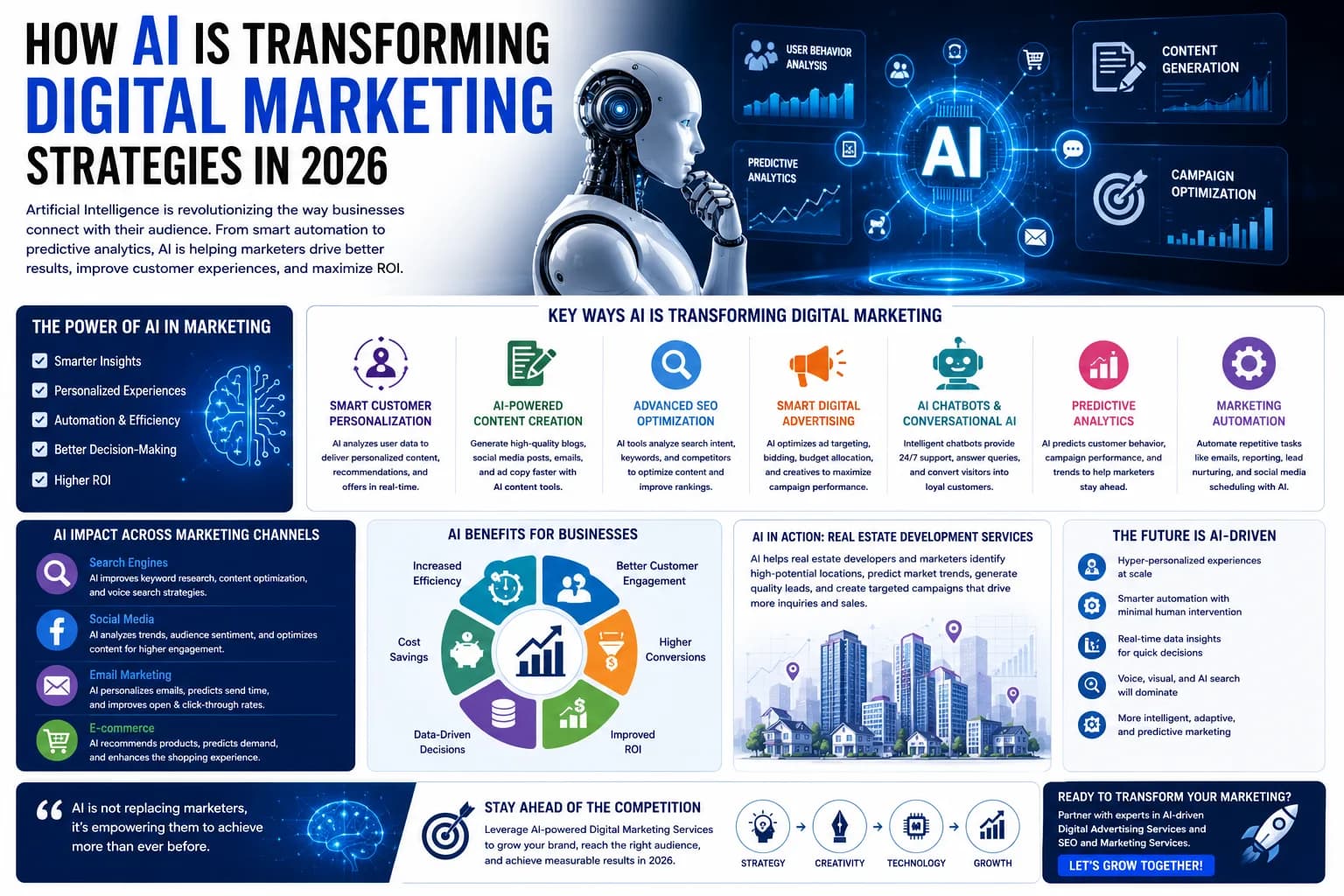
Artificial Intelligence (AI) has evolved from an emerging technology into a core component of modern digital marketing. In 2026, businesses are leveraging AI to create highly personalized customer experiences, automate repetitive marketing tasks, optimize campaigns, and generate better returns on investment.
From content creation and predictive analytics to customer segmentation and automated advertising, AI is fundamentally changing how brands connect with their audiences. Organizations investing in advanced digital advertising services and modern SEO and marketing services are increasingly using AI-powered tools to stay ahead of competitors and maximize marketing performance.
Industries ranging from retail and healthcare to real estate development services are embracing AI-driven marketing strategies to attract customers, generate leads, and improve conversion rates.
This comprehensive guide explores how AI is transforming digital marketing strategies in 2026 and why businesses must adapt to remain competitive.
The Rise of AI in Digital Marketing
Digital marketing has become increasingly data-driven. Businesses now generate vast amounts of customer information across websites, social media platforms, email campaigns, and advertising networks.
AI helps marketers process this data efficiently and uncover valuable insights that would be impossible to identify manually.
Key Benefits of AI Marketing
Improved customer targeting
Better campaign performance
Enhanced personalization
Faster decision-making
Reduced marketing costs
Increased return on investment
As AI technologies become more sophisticated, their role in marketing continues to expand.
AI-Powered Customer Personalization
One of the most significant impacts of AI is its ability to deliver personalized experiences at scale.
Modern consumers expect brands to understand their preferences and provide relevant recommendations.
AI Personalization Uses
Product recommendations
Dynamic website content
Personalized email campaigns
Customized advertising
Behavioral targeting
Business Benefits
Higher engagement rates
Improved customer satisfaction
Increased conversions
Stronger customer loyalty
Personalization is becoming a major competitive advantage in digital marketing.
AI in Content Creation
Content remains the foundation of successful digital marketing strategies.
AI-powered tools now assist marketers with:
Blog writing
Social media content
Email marketing copy
Video scripts
Product descriptions
Advantages
Faster content production
Improved consistency
Better scalability
Enhanced content optimization
While human creativity remains essential, AI significantly improves efficiency and productivity.
AI Revolutionizing SEO and Marketing Services
Search engine optimization has become more sophisticated due to advances in AI.
Modern SEO and marketing services use AI to analyze search behavior, identify ranking opportunities, and optimize content strategies.
AI Applications in SEO
Keyword Research
AI identifies emerging search trends and valuable keyword opportunities.
Content Optimization
AI analyzes content quality and provides recommendations for improvement.
Search Intent Analysis
AI helps marketers understand what users are truly looking for when they search online.
Competitive Analysis
Businesses can evaluate competitors more effectively and identify market opportunities.
SEO Benefits
Improved rankings
Increased organic traffic
Better user experience
Enhanced content relevance
AI is helping businesses achieve stronger SEO performance than ever before.
Smart Digital Advertising Campaigns
AI has transformed how businesses manage advertising campaigns.
Modern digital advertising services leverage AI to automate campaign optimization and improve targeting accuracy.
AI Advertising Capabilities
Audience segmentation
Bid optimization
Ad creative testing
Budget allocation
Performance forecasting
Benefits
Lower advertising costs
Better click-through rates
Higher conversion rates
Improved ROI
AI enables advertisers to make data-driven decisions in real time.
Predictive Analytics for Marketing Success
Predictive analytics uses historical and real-time data to forecast future customer behavior.
Predictive Marketing Applications
Purchase predictions
Customer churn analysis
Lead scoring
Demand forecasting
Campaign performance predictions
Business Impact
Predictive analytics helps marketers allocate resources more effectively and improve campaign outcomes.
AI Chatbots and Conversational Marketing
AI-powered chatbots have become a standard feature on modern websites.
Chatbot Functions
Answer customer questions
Generate leads
Schedule appointments
Provide product recommendations
Offer customer support
Benefits
24/7 availability
Faster response times
Reduced support costs
Improved customer experiences
Conversational AI improves engagement while reducing operational expenses.
Marketing Automation Through AI
Marketing automation allows businesses to streamline repetitive tasks and focus on strategic activities.
Common Automation Tasks
Email marketing
Social media scheduling
Lead nurturing
Customer segmentation
Campaign reporting
Advantages
Increased efficiency
Reduced manual workload
Better consistency
Faster campaign execution
AI-driven automation is helping businesses scale marketing operations more effectively.
AI and Social Media Marketing
Social media platforms generate enormous amounts of user data.
AI helps businesses:
Identify trending topics
Analyze audience sentiment
Optimize posting schedules
Personalize content
Improve engagement
Social Media Benefits
Better audience targeting
Increased engagement
Improved brand awareness
Higher campaign performance
AI is making social media marketing smarter and more strategic.
Voice Search and AI Optimization
Voice search continues to grow through smartphones, smart speakers, and virtual assistants.
AI Helps Marketers
Understand conversational queries
Optimize content for voice search
Improve local SEO strategies
Enhance user experiences
Businesses that adapt to voice search trends can capture additional traffic opportunities.
AI in Email Marketing
Email marketing remains one of the highest ROI marketing channels.
AI improves email campaigns through:
Smart Features
Subject line optimization
Personalized messaging
Send-time optimization
Audience segmentation
Performance prediction
Results
Higher open rates
Better click-through rates
Increased conversions
AI helps marketers deliver more relevant email experiences.
AI for Lead Generation
Generating qualified leads remains a top business priority.
AI improves lead generation by:
Identifying high-value prospects
Scoring leads automatically
Analyzing customer behavior
Predicting purchase intent
Benefits
Higher-quality leads
Faster sales cycles
Improved conversion rates
Businesses can focus resources on prospects most likely to convert.
AI Applications in Real Estate Development Services
Organizations involved in real estate development services are increasingly using AI-powered marketing strategies.
Common Applications
Property recommendation engines
Predictive buyer analysis
Automated lead generation
Virtual property tours
Personalized advertising campaigns
AI helps real estate businesses attract buyers, investors, and tenants more effectively.
Challenges of AI in Digital Marketing
While AI offers significant benefits, businesses should also be aware of potential challenges.
Common Challenges
Data privacy concerns
Technology implementation costs
Integration complexity
Dependence on data quality
Staff training requirements
Successful AI adoption requires careful planning and ongoing optimization.
Future Trends in AI Marketing
Several emerging trends are expected to shape the future of digital marketing.
Generative AI Expansion
AI-generated content will become increasingly sophisticated.
Hyper-Personalization
Marketing experiences will become even more individualized.
Predictive Customer Journeys
AI will anticipate customer needs before they arise.
Autonomous Campaign Management
AI systems will increasingly manage campaigns with minimal human intervention.
Advanced Analytics
Businesses will gain deeper insights into customer behavior and market trends.
Best Practices for Implementing AI in Marketing
Start with Clear Objectives
Define measurable business goals before implementing AI tools.
Focus on Data Quality
Accurate data improves AI performance and marketing outcomes.
Combine Human Expertise with AI
AI should support—not replace—strategic marketing decisions.
Continuously Monitor Performance
Regularly evaluate campaign effectiveness and optimize accordingly.
Invest in Training
Ensure marketing teams understand how to leverage AI technologies effectively.
Conclusion
Artificial Intelligence is transforming every aspect of digital marketing in 2026. From personalized customer experiences and predictive analytics to automated campaigns and smarter content strategies, AI is helping businesses achieve greater efficiency and stronger marketing performance.
Companies investing in advanced digital advertising services and innovative SEO and marketing services are using AI to improve customer engagement, increase conversions, and maximize return on investment.
Even industries such as real estate development services are leveraging AI-powered marketing tools to attract qualified prospects and accelerate business growth.
Organizations that embrace AI-driven marketing today will be better positioned to compete, innovate, and succeed in the rapidly evolving digital landscape.
DoddapaneniGroup.net provides advanced AI solutions, digital marketing services, software development, cloud computing, and digital transformation services designed to help businesses achieve sustainable growth in the digital era.
Disclaimer: This content is for informational purposes only.