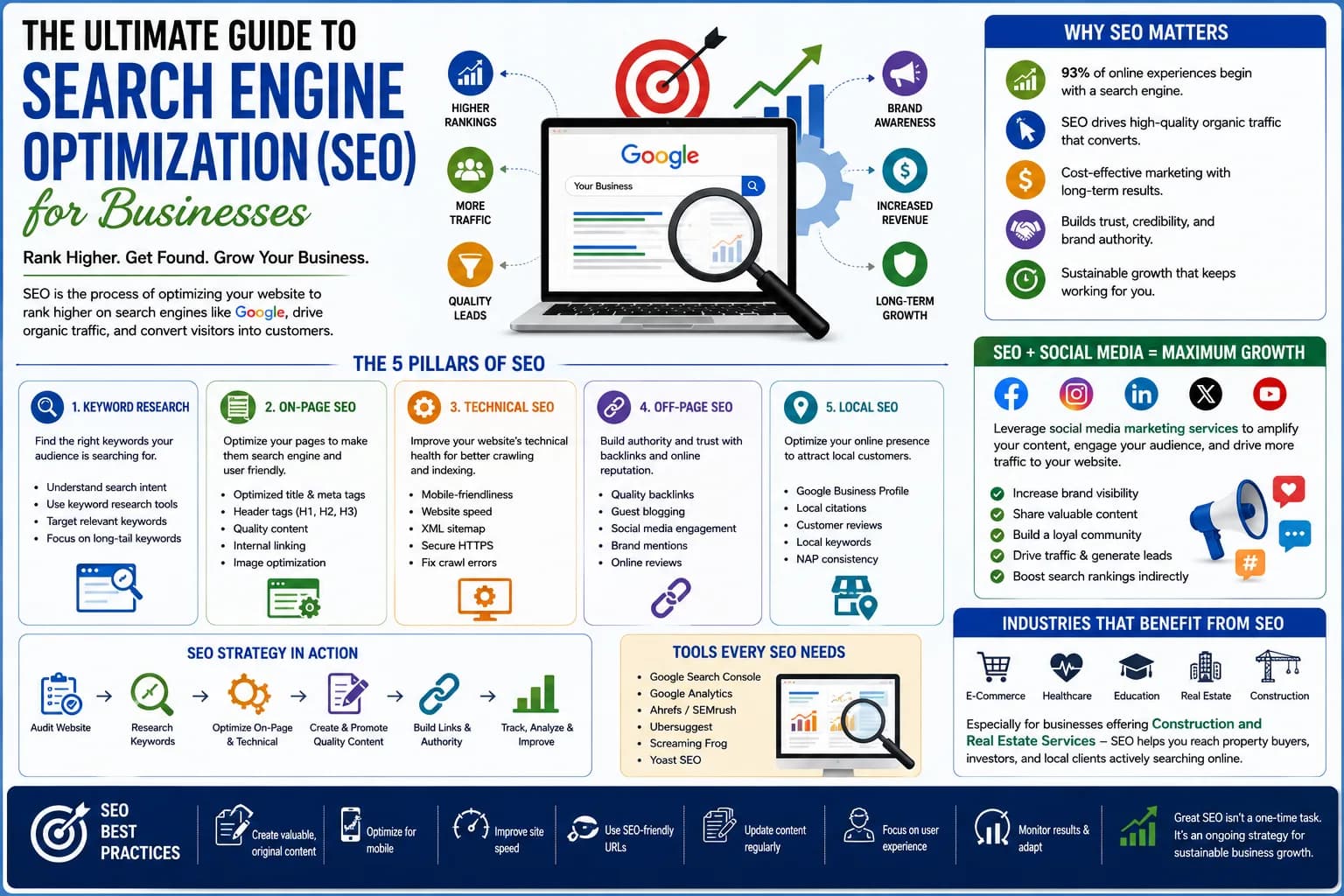
In today's digital marketplace, having a strong online presence is essential for business growth. Customers increasingly use search engines to discover products, services, companies, and solutions. If your business does not appear prominently in search results, you may be missing valuable opportunities to reach potential customers.
Search Engine Optimization (SEO) is one of the most effective ways to improve online visibility, attract qualified website visitors, and build long-term digital growth. By investing in professional SEO and marketing services, businesses can improve their search rankings, strengthen brand authority, and generate a consistent stream of organic traffic.
This guide explains the fundamentals of SEO, its benefits, key strategies, and how businesses can use SEO to achieve sustainable growth.
What Is Search Engine Optimization?
Search Engine Optimization is the process of improving a website and its content to increase its visibility in organic search engine results.
Search engines evaluate numerous factors when determining which websites should appear for a particular search query. These factors include content relevance, website structure, page experience, mobile usability, technical performance, authority, and search intent.
A successful SEO strategy focuses on helping both search engines and users understand a website's content.
SEO typically includes:
Keyword research
On-page optimization
Technical SEO
Content creation
Link building
Local SEO
Website performance optimization
Analytics and reporting
Why SEO Is Important for Businesses
SEO provides businesses with an opportunity to reach customers who are actively searching for relevant products or services.
Some of the major benefits include:
Increased Organic Traffic
Higher search rankings can generate more visitors without paying for every individual click.
Improved Brand Visibility
Appearing prominently in search results helps customers discover and remember your brand.
Better Lead Generation
SEO attracts users based on their search intent, making organic traffic valuable for lead generation.
Long-Term Growth
Unlike short-term advertising campaigns, well-executed SEO can continue generating traffic and leads over an extended period.
Increased Credibility
Businesses that consistently appear in relevant search results can build stronger authority and trust within their industries.
Understanding the Main Types of SEO
SEO is not a single activity. It consists of several interconnected areas that work together to improve website performance.
1. On-Page SEO
On-page SEO focuses on optimizing individual website pages.
Important elements include:
Page titles
Meta descriptions
Headings
Keywords
Content structure
Internal links
Image optimization
URL structure
Content should be written primarily for users while naturally incorporating relevant keywords.
2. Technical SEO
Technical SEO focuses on the technical foundation of a website.
It includes:
Website speed
Mobile responsiveness
Crawlability
Indexing
XML sitemaps
Structured data
Secure HTTPS connections
Broken-link management
A technically strong website makes it easier for search engines to discover and understand its pages.
3. Off-Page SEO
Off-page SEO involves activities that build a website's authority outside its own pages.
Common strategies include:
High-quality backlinks
Digital PR
Industry partnerships
Business listings
Brand mentions
Guest contributions
Quality is more important than simply obtaining a large number of links.
4. Local SEO
Local SEO is especially important for businesses serving specific geographic markets.
Local optimization can include:
Business profile optimization
Local keywords
Customer reviews
Location pages
Local citations
Consistent business information
A strong local SEO strategy helps customers find businesses when searching for nearby products or services.
The Importance of Keyword Research
Keyword research is one of the foundations of effective SEO.
Businesses need to understand what potential customers are searching for and why they are searching for it.
Keywords can generally be divided into:
Informational keywords
Navigational keywords
Commercial keywords
Transactional keywords
Local search terms
For example, someone searching for "what is SEO" has an informational intent, while someone searching for "SEO services for small business" is likely closer to making a purchasing decision.
Effective SEO and marketing services use keyword research to align content with different stages of the customer journey.
Creating High-Quality SEO Content
Content remains a critical part of SEO success.
Businesses should create useful content that directly answers customer questions and provides genuine value.
Effective content can include:
Blog posts
Guides
Case studies
Service pages
Industry reports
FAQs
Videos
Infographics
Instead of creating content solely to target keywords, businesses should focus on solving problems and addressing the needs of their target audience.
Internal Linking and SEO
Internal links connect different pages on your website and help users discover related information.
They also help search engines understand the structure and relationships between pages.
For example, a company offering digital services could naturally link relevant content to Construction and Real Estate Services when discussing technology and marketing solutions for property businesses.
Effective internal linking can:
Improve website navigation
Distribute page authority
Help search engines discover content
Increase time spent on the website
Support relevant keyword rankings
How Social Media Supports SEO
Social media and SEO are different digital marketing channels, but they can complement one another.
Professional social media marketing services can help businesses distribute content, increase brand awareness, and generate engagement.
Social media can support SEO by helping businesses:
Promote new content
Increase brand visibility
Build communities
Encourage content sharing
Generate referral traffic
Strengthen relationships with customers
While social signals are not generally treated as a direct ranking factor, increased visibility and engagement can create opportunities that indirectly support broader digital marketing performance.
SEO for Different Industries
SEO strategies should be adapted to the industry, target audience, competition, and business objectives.
Healthcare
Healthcare organizations can use SEO to help patients find services, educational resources, and trusted information.
Technology
Technology companies can use SEO to promote software products, technical solutions, and industry expertise.
E-Commerce
Online stores can optimize product pages, category pages, buying guides, and informational content to attract shoppers.
Construction and Real Estate
Businesses operating in Construction and Real Estate Services can use SEO to reach property buyers, investors, developers, contractors, and other audiences.
Strategies may include:
Local property keywords
Project pages
Location-specific content
Construction guides
Property market articles
Project showcases
Local business optimization
SEO can help real estate and construction businesses generate qualified inquiries while building long-term online visibility.
How SEO and Social Media Work Together
Combining SEO with social media marketing services creates a broader digital marketing strategy.
For example, a business can:
Research customer questions.
Create an SEO-optimized blog post.
Publish the content on its website.
Share it across social media platforms.
Use social engagement to expand content reach.
Monitor traffic and conversions.
Update the content based on performance.
This integrated approach helps businesses maximize the value of their content investments.
Common SEO Mistakes Businesses Should Avoid
Many organizations struggle with SEO because they focus on shortcuts rather than sustainable strategies.
Common mistakes include:
Keyword Stuffing
Repeating keywords excessively can make content difficult to read and may harm the user experience.
Publishing Low-Quality Content
Creating large amounts of content without providing meaningful value rarely produces sustainable results.
Ignoring Technical SEO
Slow websites, broken links, indexing problems, and poor mobile experiences can negatively affect performance.
Neglecting Local Search
Businesses serving specific locations can lose valuable opportunities by failing to optimize for local searches.
Buying Low-Quality Backlinks
Poor-quality or manipulative link-building practices can create long-term SEO risks.
Not Measuring Results
Without analytics, businesses cannot determine which strategies are generating traffic, leads, and conversions.
Measuring SEO Performance
SEO should be measured using meaningful business and website metrics.
Important metrics include:
Organic traffic
Keyword rankings
Click-through rate
Conversion rate
Qualified leads
Bounce or engagement metrics
Indexed pages
Backlink quality
Revenue generated from organic traffic
The most important goal is not simply achieving higher rankings. Successful SEO should contribute to business outcomes such as leads, sales, customer acquisition, and revenue.
SEO Trends Businesses Should Watch
Search is continuing to evolve as artificial intelligence and new search experiences become more prominent.
Important trends include:
AI-assisted search
Conversational search
Voice search
Visual search
Local search optimization
First-hand expertise
Structured data
Helpful, user-focused content
Personalized search experiences
Businesses should focus on creating trustworthy, useful, original content while maintaining strong technical foundations.
How Long Does SEO Take to Produce Results?
SEO is a long-term marketing strategy rather than an instant solution.
The time required to see meaningful results depends on factors such as:
Website authority
Industry competition
Keyword difficulty
Content quality
Technical condition
Backlink profile
Consistency of optimization
Some improvements may appear relatively quickly, while competitive keywords can require months of sustained effort.
Why Businesses Should Invest in Professional SEO Services
Managing SEO requires knowledge of search algorithms, content strategy, technical optimization, analytics, and industry trends.
Professional SEO and marketing services can provide businesses with:
Strategic keyword research
Website audits
Content optimization
Technical SEO
Local SEO
Link-building strategies
Performance reporting
Ongoing optimization
A professional approach allows businesses to focus on their core operations while specialists manage their online visibility.
Conclusion
Search Engine Optimization is an essential component of modern digital marketing. By optimizing websites, creating valuable content, targeting relevant search terms, and maintaining strong technical performance, businesses can improve visibility and attract qualified customers.
Combining professional SEO and marketing services with effective social media marketing services can create a powerful digital strategy that supports brand awareness, customer engagement, lead generation, and long-term growth.
Businesses in industries ranging from technology and healthcare to Construction and Real Estate Services can benefit from a strategic SEO approach tailored to their audiences and objectives.
If your business is ready to improve its online presence, increase organic traffic, and generate more qualified leads, Doddapaneni Group (Doddapanenigroup.net) offers SEO, digital marketing, technology, and business solutions designed to support sustainable growth.