Introduction
Businesses across every industry are under constant pressure to improve efficiency, reduce expenses, and remain competitive. In 2026, Artificial Intelligence (AI) automation has become one of the most effective technologies for achieving these goals. Organizations are leveraging AI-powered tools to automate repetitive tasks, streamline workflows, enhance decision-making, and significantly reduce operational costs.
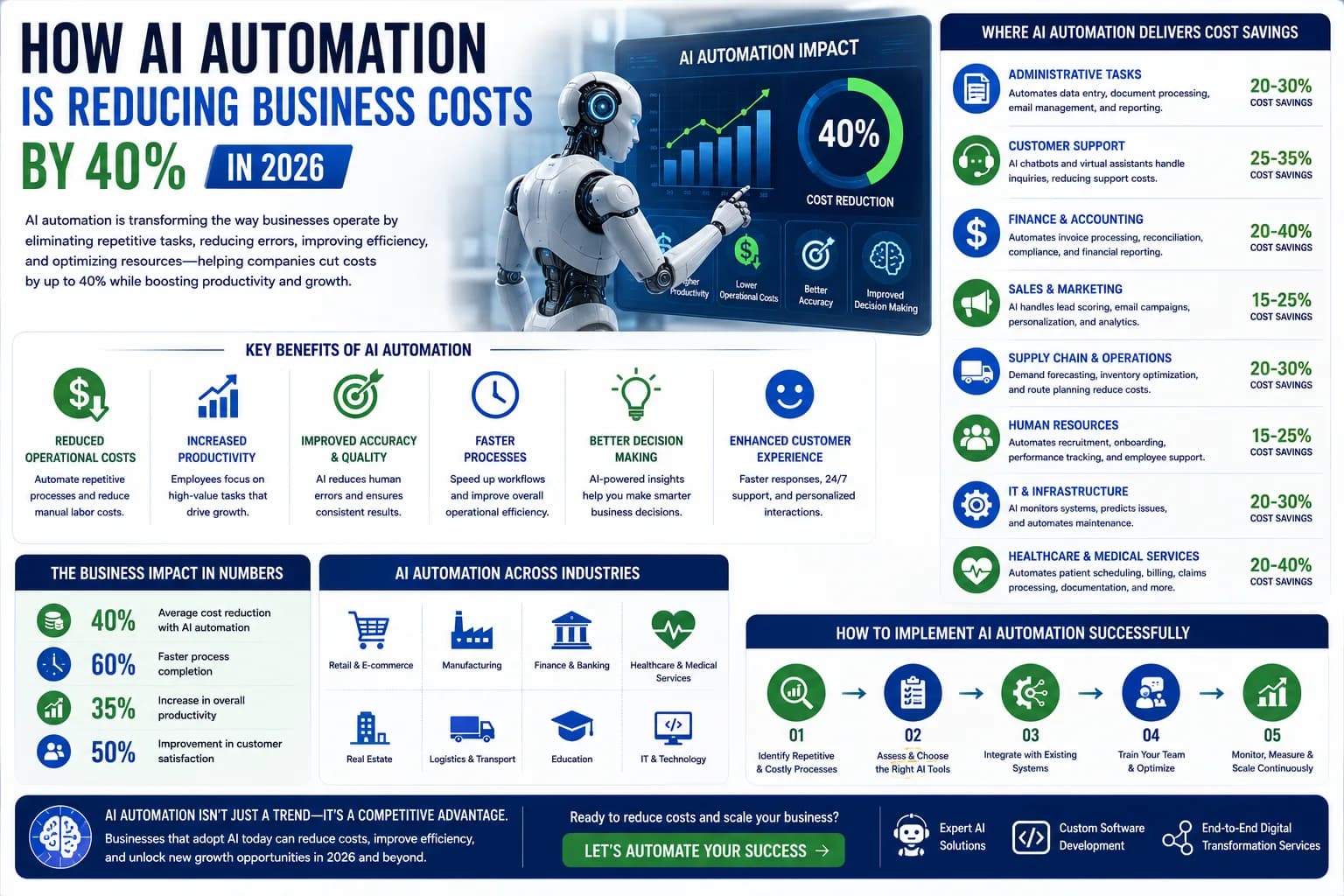
Studies and industry reports consistently show that businesses implementing AI automation can reduce operational expenses by up to 40% while improving productivity and customer satisfaction. From customer service and marketing to finance, manufacturing, and Healthcare and Medical Services, AI is transforming how organizations operate.
Companies investing in advanced digital transformation services and tailored custom software development solutions are gaining a significant competitive advantage by optimizing business processes and maximizing efficiency.
This guide explores how AI automation works, where cost savings come from, and why it is becoming an essential component of modern business strategies.
What Is AI Automation?
AI automation combines Artificial Intelligence, Machine Learning, and workflow automation technologies to perform tasks with minimal human intervention.
Unlike traditional automation, AI systems can:
Learn from data
Recognize patterns
Make predictions
Process natural language
Improve performance over time
This enables businesses to automate both simple and complex operations.
Why Businesses Are Investing in AI Automation
Organizations are facing increasing challenges such as:
Rising labor costs
Growing customer expectations
Operational inefficiencies
Competitive market pressures
Data management complexities
AI automation helps address these challenges while improving overall business performance.
Key Benefits
Lower operating costs
Increased productivity
Better decision-making
Faster service delivery
Improved customer experiences
These advantages are driving widespread adoption across industries.
How AI Automation Reduces Business Costs
Automating Repetitive Tasks
Many business processes involve repetitive activities that consume valuable employee time.
Common Examples
Data entry
Invoice processing
Appointment scheduling
Email responses
Report generation
AI automation handles these tasks faster and more accurately than manual processes.
Cost Savings
Businesses reduce labor expenses while allowing employees to focus on higher-value activities.
Reducing Human Errors
Human mistakes can lead to financial losses, compliance issues, and operational disruptions.
AI systems improve accuracy by:
Processing data consistently
Following predefined rules
Identifying anomalies
Reducing manual intervention
Benefits
Fewer costly errors
Improved compliance
Better operational reliability
Error reduction directly contributes to lower business costs.
Improving Workforce Productivity
AI tools assist employees by automating routine responsibilities.
Productivity Improvements
Employees can spend more time on:
Strategic planning
Customer relationships
Innovation
Business development
Higher productivity allows organizations to achieve more without increasing staffing levels.
Optimizing Customer Support
Customer service departments often handle large volumes of repetitive inquiries.
AI Solutions Include
Chatbots
Virtual assistants
Automated ticket routing
Self-service support systems
Benefits
Reduced support costs
Faster response times
24/7 customer assistance
Improved satisfaction rates
AI customer service automation significantly lowers operational expenses.
Role of Digital Transformation Services in AI Adoption
Successful AI implementation often begins with professional digital transformation services.
These services help organizations:
Assess Existing Processes
Identify areas suitable for automation.
Develop Digital Strategies
Create roadmaps for technology adoption.
Integrate AI Technologies
Ensure seamless implementation across business operations.
Optimize Workflows
Redesign processes to maximize efficiency.
Measure Results
Track performance improvements and ROI.
Digital transformation initiatives ensure businesses achieve maximum value from AI investments.
Custom Software Development and AI Automation
Every organization has unique operational requirements.
Professional custom software development enables businesses to create AI-powered solutions tailored to their specific needs.
Examples Include
Workflow automation platforms
Intelligent CRM systems
AI-powered analytics tools
Automated inventory management
Predictive maintenance systems
Custom-built applications often provide greater flexibility and long-term value than off-the-shelf software.
AI Automation in Finance and Accounting
Finance departments are among the biggest beneficiaries of AI automation.
Automated Processes
Invoice processing
Expense management
Financial reporting
Fraud detection
Tax calculations
Results
Reduced administrative costs
Faster financial operations
Improved accuracy
Better compliance management
Financial automation improves both efficiency and profitability.
AI in Sales and Marketing
AI is transforming sales and marketing operations.
Marketing Applications
Lead scoring
Customer segmentation
Campaign optimization
Personalized content
Predictive analytics
Sales Applications
Prospect identification
Automated follow-ups
Sales forecasting
CRM automation
Businesses achieve better results while reducing marketing and sales expenses.
AI Automation in Supply Chain Management
Supply chain operations generate significant costs for many organizations.
AI Helps With
Demand forecasting
Inventory optimization
Route planning
Supplier management
Logistics automation
Benefits
Lower inventory costs
Reduced waste
Faster deliveries
Improved operational efficiency
Supply chain automation creates substantial cost savings.
AI-Powered Data Analytics
Modern businesses generate enormous amounts of data.
AI analytics solutions help organizations:
Identify trends
Predict outcomes
Optimize operations
Improve decision-making
Cost Reduction Benefits
Better decisions reduce wasted resources and improve overall efficiency.
AI Automation in Healthcare and Medical Services
Organizations providing Healthcare and Medical Services are increasingly adopting AI automation.
Healthcare Applications
Patient Scheduling
Automated appointment management reduces administrative workloads.
Medical Documentation
AI assists with clinical documentation and record management.
Billing and Claims Processing
Automation improves accuracy and reduces processing times.
Patient Monitoring
AI systems support proactive healthcare management.
Benefits
Lower operational costs
Improved patient experiences
Increased staff productivity
Better healthcare outcomes
Healthcare organizations are seeing significant returns from AI investments.
Predictive Maintenance and Asset Management
AI-powered predictive maintenance helps businesses avoid costly equipment failures.
Benefits Include
Reduced downtime
Lower repair costs
Extended equipment lifespan
Improved operational reliability
Manufacturing and industrial organizations particularly benefit from these capabilities.
AI Automation for Human Resources
HR departments use AI to streamline administrative processes.
Common Applications
Resume screening
Candidate matching
Employee onboarding
Performance analysis
Workforce planning
Automation reduces recruitment costs and improves employee experiences.
Real-Time Business Intelligence
AI-powered dashboards provide instant access to critical business information.
Benefits
Faster decision-making
Improved forecasting
Better resource allocation
Increased operational visibility
Real-time insights help organizations identify cost-saving opportunities quickly.
Challenges of AI Automation Implementation
While AI offers substantial benefits, businesses should prepare for several challenges.
Common Challenges
Initial Investment Costs
Technology implementation may require upfront spending.
Change Management
Employees may need training and support.
Data Quality Issues
AI systems depend on accurate data.
Integration Complexity
New technologies must work with existing systems.
A strategic implementation approach helps overcome these challenges.
Future Trends in AI Automation
Several emerging innovations will further increase business efficiency.
Generative AI
Advanced content creation and decision support.
Hyperautomation
Combining multiple technologies for end-to-end automation.
Autonomous Business Processes
AI systems managing entire workflows independently.
Intelligent Decision-Making
Real-time recommendations and predictive actions.
Industry-Specific AI Platforms
Customized solutions tailored to unique business requirements.
These trends will continue driving cost reductions and operational improvements.
Best Practices for AI Automation Success
Start with High-Impact Processes
Focus on areas with the greatest cost-saving potential.
Define Clear Objectives
Establish measurable goals before implementation.
Invest in Quality Data
Accurate data improves AI effectiveness.
Partner with Experienced Technology Providers
Professional guidance accelerates success.
Continuously Optimize
Monitor performance and refine automation strategies regularly.
Conclusion
AI automation is rapidly becoming one of the most effective ways for businesses to reduce operational costs, improve productivity, and remain competitive in 2026. By automating repetitive tasks, enhancing decision-making, and optimizing workflows, organizations can achieve significant efficiency gains and reduce expenses by as much as 40%.
Companies investing in professional digital transformation services and customized custom software development solutions are unlocking new opportunities for growth and innovation across every business function.
Even industries such as Healthcare and Medical Services are leveraging AI automation to improve operational efficiency, enhance customer experiences, and deliver better outcomes.
Businesses that embrace AI automation today will be better positioned to succeed in the increasingly digital and data-driven future.
DoddapaneniGroup.net provides advanced AI solutions, software development, cloud technologies, and digital transformation services designed to help businesses automate operations, reduce costs, and accelerate growth.
Disclaimer: This content is for informational purposes only and should not be considered financial, legal, or technology implementation advice.