Introduction
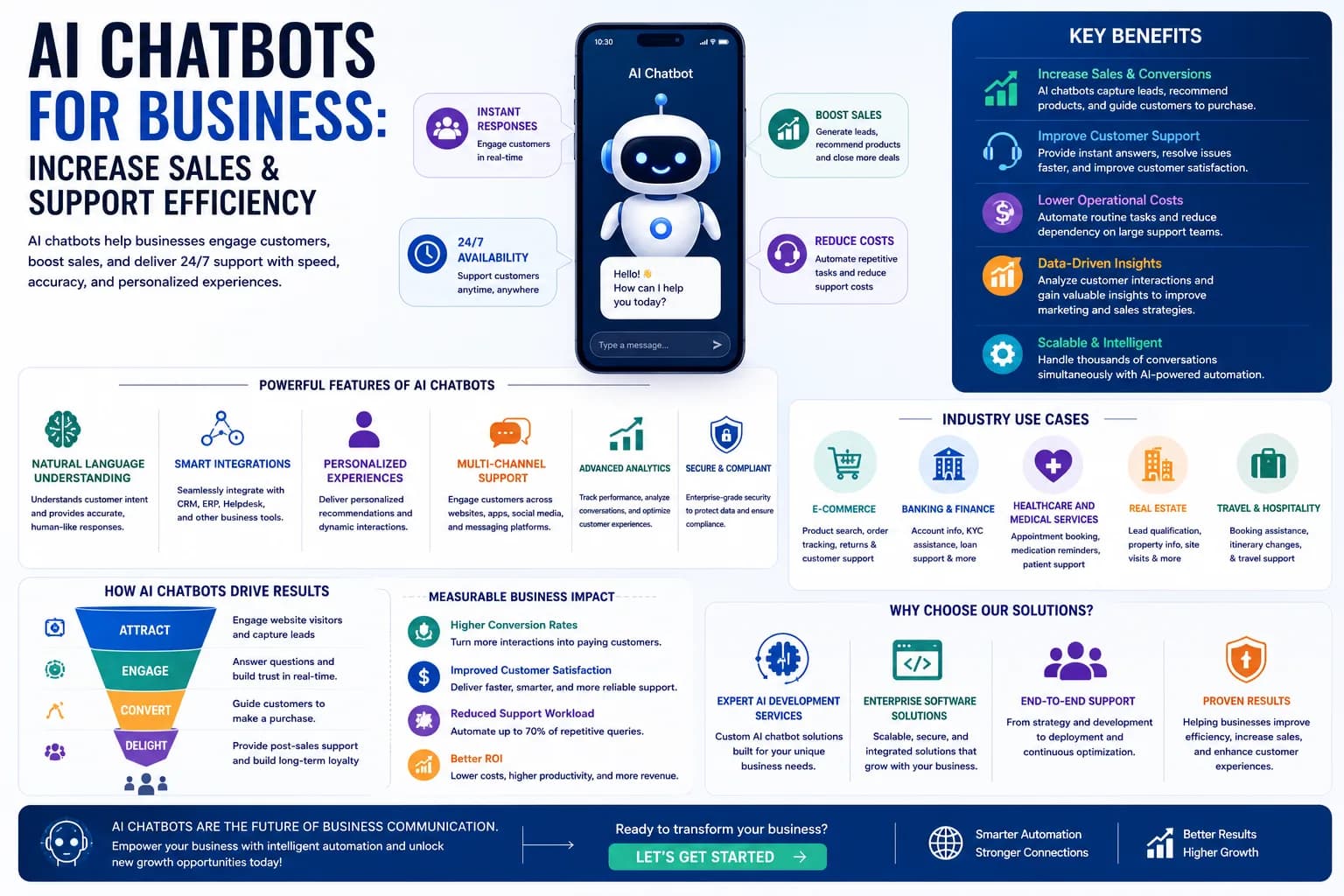
Businesses in 2026 are expected to provide instant responses, personalized experiences, and round-the-clock customer support. As customer expectations continue to rise, organizations are increasingly turning to AI chatbots to improve communication, streamline operations, and boost revenue.
AI-powered chatbots have evolved far beyond simple automated responses. Modern chatbots can understand customer intent, answer complex questions, generate leads, process transactions, and provide intelligent support across multiple channels.
Companies investing in advanced AI development services and scalable enterprise software solutions are leveraging chatbot technology to increase sales, reduce support costs, and improve customer satisfaction.
From retail and finance to Healthcare and Medical Services, AI chatbots are becoming essential tools for organizations seeking to enhance customer engagement and operational efficiency.
This comprehensive guide explores how AI chatbots work, their benefits, business applications, implementation strategies, and future trends in 2026.
What Are AI Chatbots?
AI chatbots are software applications that use Artificial Intelligence, Natural Language Processing (NLP), and Machine Learning to simulate human-like conversations.
Unlike traditional rule-based chatbots, AI chatbots can:
Understand context
Learn from interactions
Interpret customer intent
Provide personalized responses
Handle complex conversations
These capabilities make AI chatbots powerful tools for modern businesses.
Why Businesses Are Adopting AI Chatbots
Customer expectations have changed significantly.
Today's consumers expect:
Instant support
Personalized interactions
24/7 availability
Quick problem resolution
Seamless digital experiences
AI chatbots help businesses meet these expectations while improving efficiency and reducing operational costs.
How AI Chatbots Increase Sales
One of the primary reasons businesses invest in chatbot technology is revenue growth.
Lead Generation Automation
AI chatbots can automatically:
Engage website visitors
Collect contact information
Qualify prospects
Schedule appointments
Route leads to sales teams
This helps businesses generate more qualified leads without increasing staffing costs.
Benefits
Faster lead capture
Improved conversion rates
Better customer engagement
Increased sales opportunities
Personalized Product Recommendations
AI chatbots analyze customer behavior and preferences to provide tailored recommendations.
Examples Include
Product suggestions
Service recommendations
Upselling opportunities
Cross-selling opportunities
Personalized recommendations often result in higher average order values and improved customer satisfaction.
Real-Time Customer Assistance
Customers often abandon purchases when they cannot find answers quickly.
AI chatbots provide immediate support by answering questions about:
Products
Pricing
Shipping
Features
Availability
This helps reduce cart abandonment and improve conversions.
Sales Funnel Optimization
Chatbots support customers throughout the buying journey.
Funnel Stages Supported
Awareness
Providing information about products and services.
Consideration
Answering detailed questions and offering comparisons.
Decision
Helping customers complete purchases and transactions.
This continuous engagement improves overall sales performance.
How AI Chatbots Improve Customer Support Efficiency
Customer service departments often face high volumes of repetitive inquiries.
AI chatbots automate routine interactions, allowing support teams to focus on more complex issues.
24/7 Customer Support
Unlike human agents, AI chatbots are available at all times.
Benefits
Faster response times
Improved customer satisfaction
Reduced wait times
Global service availability
Businesses can provide support even outside normal working hours.
Reduced Support Costs
AI chatbots handle a large percentage of customer inquiries automatically.
Common Tasks Automated
FAQ responses
Order tracking
Appointment scheduling
Account assistance
Basic troubleshooting
Automation reduces staffing requirements and operational expenses.
Consistent Customer Experiences
Human responses may vary depending on the agent.
AI chatbots provide:
Consistent messaging
Accurate information
Standardized support experiences
This helps maintain service quality across all customer interactions.
Role of AI Development Services in Chatbot Success
Successful chatbot implementation requires professional expertise.
Modern AI development services help businesses design, develop, and deploy intelligent chatbot systems tailored to specific operational needs.
AI Development Services Include
Custom chatbot development
NLP integration
Machine learning implementation
Workflow automation
Conversational design
AI model training
Custom solutions provide better performance than generic chatbot platforms.
Enterprise Software Solutions and Chatbot Integration
Modern businesses often operate multiple software systems.
Advanced enterprise software solutions enable chatbots to integrate seamlessly with:
CRM platforms
ERP systems
Customer support software
Marketing automation tools
E-commerce platforms
Benefits of Integration
Centralized customer data
Improved automation
Better reporting
Enhanced customer experiences
Integrated systems maximize chatbot effectiveness.
AI Chatbots in Healthcare and Medical Services
The healthcare industry is increasingly adopting chatbot technology.
Organizations providing Healthcare and Medical Services use AI chatbots for:
Appointment Scheduling
Patients can book appointments automatically.
Patient Support
Chatbots answer common healthcare questions.
Medication Reminders
Automated reminders improve treatment adherence.
Insurance Verification
Patients receive instant insurance-related assistance.
Telehealth Support
Chatbots guide patients through virtual consultation processes.
These applications improve efficiency while enhancing patient experiences.
AI Chatbots for Marketing and Lead Nurturing
Marketing teams use chatbots to engage prospects and guide them through the customer journey.
Marketing Applications
Website engagement
Lead qualification
Campaign support
Survey collection
Event registration
Chatbots help businesses convert more visitors into customers.
AI Chatbots for E-Commerce Businesses
E-commerce companies use chatbots extensively to improve shopping experiences.
Common Features
Product recommendations
Order tracking
Cart recovery
Customer support
Returns assistance
These capabilities improve customer satisfaction and increase revenue.
Key Features of Modern AI Chatbots
Natural Language Processing
NLP enables chatbots to understand human language naturally.
Machine Learning
Machine learning allows chatbots to improve performance over time.
Multilingual Support
Businesses can serve global audiences more effectively.
Omnichannel Communication
Chatbots can operate across:
Websites
Mobile apps
Social media
Messaging platforms
Analytics and Reporting
Businesses gain valuable insights into customer behavior and chatbot performance.
Benefits of AI Chatbots for Businesses
Increased Sales
Personalized engagement improves conversion rates.
Lower Operating Costs
Automation reduces support expenses.
Better Customer Satisfaction
Instant assistance improves customer experiences.
Higher Productivity
Employees focus on strategic tasks rather than repetitive inquiries.
Improved Scalability
Businesses can handle increasing customer demand without significant staffing increases.
Challenges of Chatbot Implementation
While chatbots offer significant benefits, organizations should address several challenges.
Common Challenges
Integration complexity
Initial development costs
Data privacy concerns
Employee training requirements
Continuous optimization needs
Proper planning helps maximize chatbot success.
Future Trends in AI Chatbots
Several innovations will shape chatbot technology in the coming years.
Generative AI Chatbots
More advanced and human-like conversations.
Voice-Enabled Chatbots
Voice interactions will become increasingly common.
Predictive Customer Assistance
AI will anticipate customer needs before requests are made.
Emotional Intelligence
Future chatbots may recognize customer emotions and adapt responses accordingly.
Industry-Specific AI Assistants
Highly specialized chatbots will support specific business sectors.
Best Practices for Successful Chatbot Deployment
Define Clear Objectives
Establish measurable goals before implementation.
Focus on User Experience
Design intuitive and helpful conversations.
Integrate Business Systems
Connect chatbots with existing enterprise platforms.
Continuously Improve Performance
Monitor analytics and optimize interactions regularly.
Balance Automation and Human Support
Provide escalation options when human assistance is needed.
Conclusion
AI chatbots are transforming how businesses interact with customers in 2026. By automating support processes, enhancing customer experiences, and generating qualified leads, chatbots help organizations improve efficiency while driving revenue growth.
Businesses investing in professional AI development services and scalable enterprise software solutions are gaining competitive advantages through intelligent automation and enhanced customer engagement.
From retail and finance to Healthcare and Medical Services, AI chatbots are becoming essential tools for delivering faster, smarter, and more personalized customer experiences.
DoddapaneniGroup.net provides advanced AI solutions, enterprise software development, cloud technologies, and digital transformation services that help businesses implement intelligent chatbot systems and achieve sustainable growth.
Disclaimer: This content is for informational purposes only.