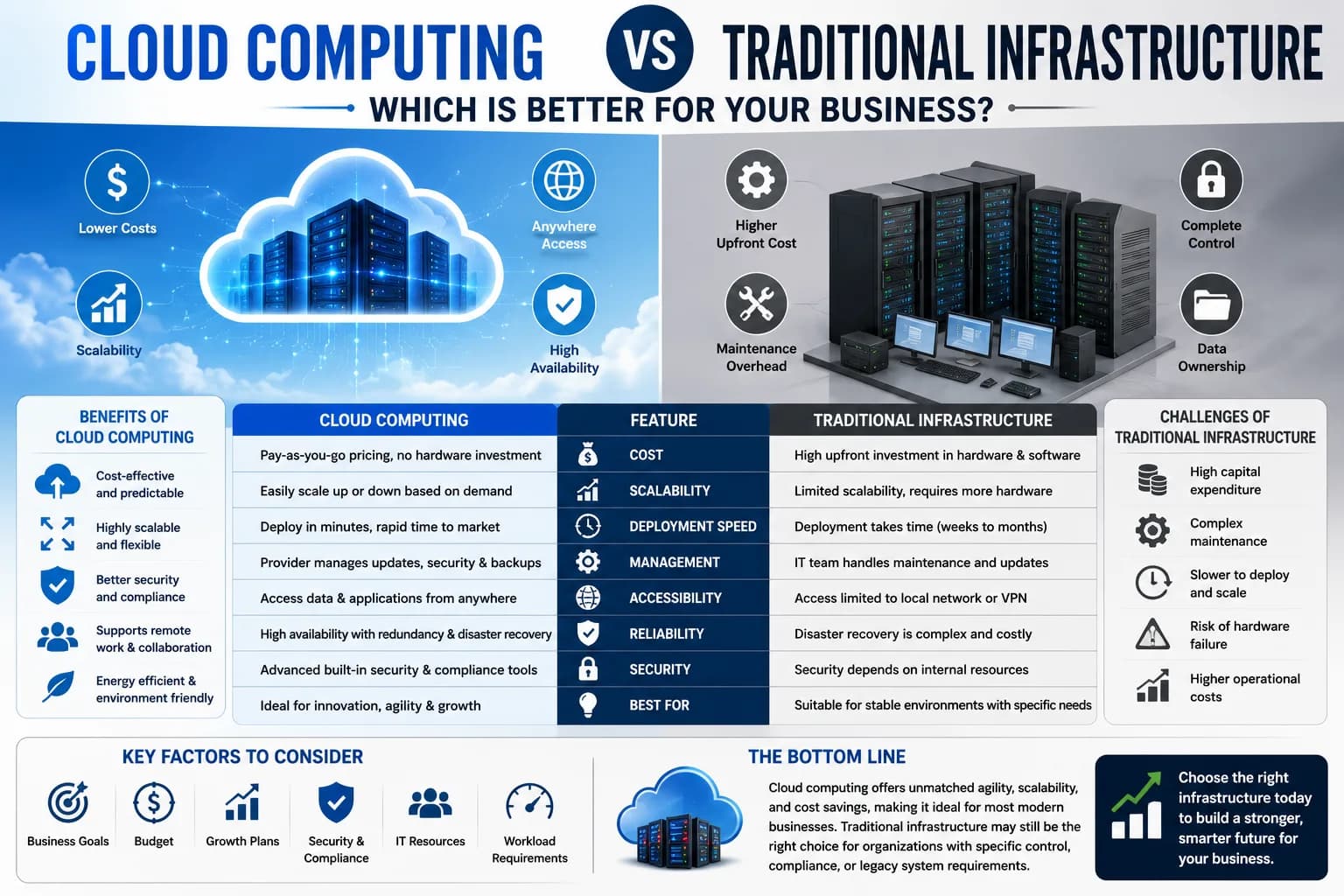
In today's fast-paced digital economy, businesses rely heavily on technology to manage operations, improve productivity, and deliver exceptional customer experiences. One of the biggest decisions organizations face is whether to adopt cloud computing or continue using traditional on-premises IT infrastructure. As businesses increasingly embrace custom software development and intelligent automation solutions, choosing the right infrastructure has become a critical factor in achieving long-term success.
While traditional infrastructure has served businesses for decades, cloud computing offers greater flexibility, scalability, and cost efficiency. Understanding the strengths and limitations of both approaches can help organizations make informed technology investments based on their business needs.
What Is Cloud Computing?
Cloud computing is the delivery of computing services—including servers, storage, databases, networking, software, and analytics—over the internet.
Instead of purchasing and maintaining physical hardware, businesses can access cloud resources on demand through cloud service providers.
Common cloud services include:
Cloud storage
Virtual servers
Database management
Software as a Service (SaaS)
Infrastructure as a Service (IaaS)
Platform as a Service (PaaS)
Cloud computing enables organizations to scale resources quickly while reducing infrastructure costs.
What Is Traditional Infrastructure?
Traditional infrastructure refers to on-premises IT systems where businesses own and maintain their own physical servers, networking equipment, and data centers.
Organizations are responsible for:
Hardware procurement
Software installation
Security management
Maintenance
System upgrades
Data backups
Although traditional infrastructure provides complete control, it often requires significant capital investment and ongoing maintenance.
Cloud Computing vs Traditional Infrastructure
Feature
Cloud Computing
Traditional Infrastructure
Initial Cost
Low
High
Scalability
Excellent
Limited
Maintenance
Managed by provider
Managed internally
Accessibility
Anywhere with internet
Primarily on-site
Deployment Speed
Fast
Slower
Security
Advanced cloud security
Organization-managed
Flexibility
Highly flexible
Less flexible
Both options have advantages, but cloud computing has become the preferred choice for many growing businesses.
Benefits of Cloud Computing
1. Lower Infrastructure Costs
Cloud platforms eliminate the need for expensive hardware purchases and reduce maintenance expenses.
Businesses save on:
Server equipment
Data center costs
Power consumption
Hardware upgrades
IT maintenance
This makes cloud computing a cost-effective solution for organizations of all sizes.
2. Scalability and Flexibility
Cloud resources can be increased or reduced based on business requirements.
Organizations can easily:
Add storage
Expand computing power
Support remote teams
Handle seasonal demand
Scalability allows businesses to grow without major infrastructure investments.
3. Remote Accessibility
Cloud-based applications can be accessed securely from virtually anywhere with an internet connection.
This supports:
Remote work
Hybrid teams
Global collaboration
Mobile workforce
Improved accessibility increases employee productivity and operational flexibility.
4. Enhanced Disaster Recovery
Cloud providers offer automated backup and disaster recovery solutions that help minimize downtime during unexpected events.
Benefits include:
Data redundancy
Faster recovery
Business continuity
Reduced data loss
5. Automatic Updates
Cloud providers regularly update infrastructure, security, and software without disrupting business operations.
Organizations always benefit from:
Latest security patches
Improved performance
New features
Reduced maintenance workload
Benefits of Traditional Infrastructure
Greater Control
Businesses maintain complete ownership of hardware, software, and security configurations.
This can be important for organizations with specialized operational requirements.
Custom Security Policies
Organizations can implement highly customized security controls based on their internal compliance requirements.
Offline Availability
Some on-premises applications continue functioning even during internet outages, depending on the system architecture.
Long-Term Investment
For organizations with stable infrastructure needs and existing IT expertise, traditional infrastructure may remain a viable long-term solution.
The Role of Custom Software Development
Modern businesses increasingly invest in custom software development to create applications tailored to their unique operational requirements.
Custom software offers:
Personalized business workflows
Better user experiences
Seamless integration
Enhanced security
Greater scalability
Cloud-native custom software allows businesses to maximize flexibility while improving operational efficiency.
Intelligent Automation Solutions in Cloud Environments
Cloud platforms provide an ideal foundation for implementing intelligent automation solutions.
Automation technologies include:
Artificial Intelligence (AI)
Machine Learning
Robotic Process Automation (RPA)
Predictive Analytics
Workflow Automation
Intelligent Chatbots
These technologies help organizations:
Reduce manual work
Improve decision-making
Increase productivity
Enhance customer experiences
Cloud infrastructure enables these automation tools to operate efficiently at scale.
Cloud Computing Across Industries
Healthcare
Healthcare organizations increasingly rely on cloud technology to manage patient records, telemedicine platforms, and medical healthcare solutions.
Cloud-based healthcare systems improve:
Patient data accessibility
Care coordination
Security
Regulatory compliance
Operational efficiency
Retail
Retail businesses use cloud platforms for:
E-commerce
Inventory management
Customer analytics
Digital payments
Finance
Financial institutions leverage cloud computing for:
Fraud detection
Secure transactions
Real-time analytics
Regulatory reporting
Manufacturing
Manufacturers benefit from:
Smart factories
IoT monitoring
Supply chain management
Predictive maintenance
Education
Educational institutions use cloud platforms for:
Online learning
Student management
Collaboration tools
Digital classrooms
Challenges of Cloud Computing
Although cloud computing offers numerous advantages, businesses should also consider:
Internet Dependency
Reliable internet connectivity is essential for accessing cloud services.
Data Privacy
Organizations should choose trusted cloud providers with strong security standards.
Ongoing Subscription Costs
Cloud services typically operate on monthly or annual subscription models.
Vendor Lock-In
Migrating between cloud providers may require careful planning.
When Traditional Infrastructure Is Still the Better Choice
Traditional infrastructure may be appropriate for organizations that:
Require complete infrastructure control
Operate in highly regulated environments
Have specialized legacy applications
Possess large internal IT teams
Maintain significant existing infrastructure investments
Many businesses also adopt hybrid environments that combine cloud and on-premises systems.
Future Trends in Business Infrastructure
Technology continues evolving rapidly.
Emerging infrastructure trends include:
Multi-cloud environments
Hybrid cloud computing
Edge computing
AI-powered infrastructure management
Serverless computing
Intelligent automation
Cloud-native application development
These innovations are helping businesses become more agile, secure, and competitive.
Which Infrastructure Is Right for Your Business?
The best choice depends on your organization's goals.
Choose cloud computing if you need:
Scalability
Lower upfront costs
Remote accessibility
Faster deployment
Flexible growth
Choose traditional infrastructure if you require:
Complete control
Specialized hardware
Custom compliance environments
Legacy application support
Many organizations achieve the best results by combining both approaches in a hybrid infrastructure model.
Conclusion
Cloud computing is transforming how businesses operate by offering greater flexibility, scalability, and cost efficiency compared to traditional infrastructure. Organizations investing in custom software development and intelligent automation solutions can leverage cloud technologies to improve productivity, accelerate innovation, and support long-term growth.
Industries such as healthcare, finance, retail, manufacturing, and education are already benefiting from cloud-powered medical healthcare solutions and intelligent business applications that enhance operational performance and customer experiences.
If your organization is planning its digital transformation journey, Doddapaneni Group (Doddapanenigroup.net) provides expert cloud consulting, custom software development, AI solutions, and enterprise technology services to help businesses build a future-ready IT infrastructure.