Introduction
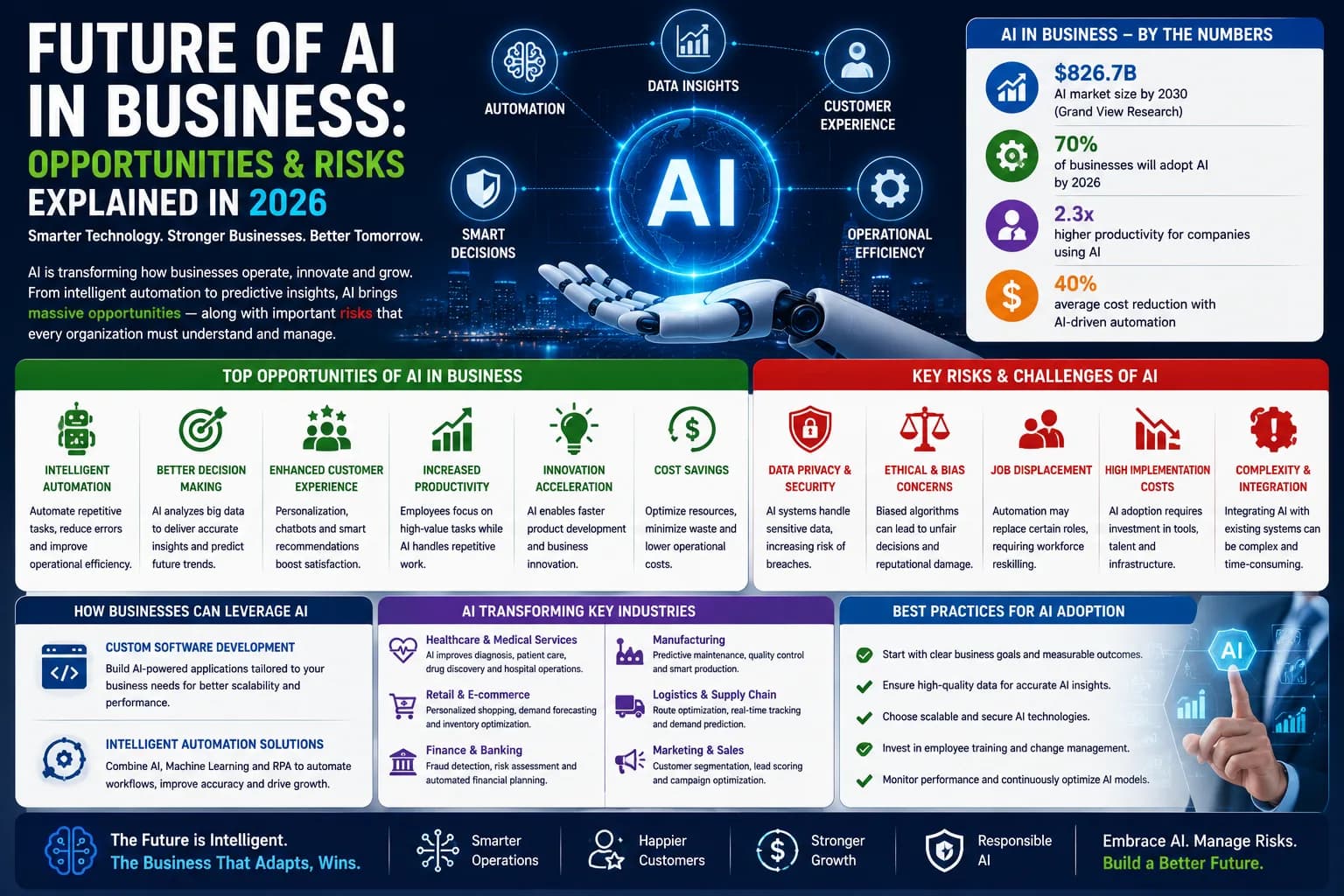
Artificial Intelligence (AI) is transforming the global business landscape in 2026. From automating repetitive tasks to improving customer experiences and predictive decision-making, AI has become a major driver of innovation and operational efficiency across industries.
Businesses today are leveraging AI technologies to improve productivity, reduce costs, personalize services, and accelerate digital transformation. Organizations adopting advanced custom software development and modern intelligent automation solutions are gaining competitive advantages in rapidly evolving markets.
Industries such as finance, retail, manufacturing, logistics, and even Healthcare and Medical Services are integrating AI-powered systems to improve efficiency, analytics, and customer satisfaction.
However, while AI creates enormous opportunities, it also introduces significant risks related to cybersecurity, data privacy, workforce disruption, and ethical concerns.
This guide explores the future of AI in business, its opportunities, challenges, and strategies organizations should consider in 2026.
What Is Artificial Intelligence in Business?
Artificial Intelligence refers to computer systems that can perform tasks requiring human intelligence.
AI Capabilities Include:
Data analysis
Predictive analytics
Natural language processing
Machine learning
Automation
Decision-making assistance
AI systems continuously learn from data and improve performance over time.
Why AI Is Growing Rapidly in 2026
Businesses are increasingly adopting AI because of:
Rising data volumes
Demand for automation
Need for operational efficiency
Faster decision-making requirements
Increased digital competition
AI technologies help organizations scale operations and improve customer experiences more effectively.
Major Opportunities of AI in Business
Intelligent Process Automation
AI automates repetitive and time-consuming tasks.
Examples Include:
Customer support automation
Invoice processing
Workflow management
Inventory tracking
Businesses using intelligent automation solutions reduce operational costs and improve efficiency.
Improved Customer Experience
AI-powered systems help businesses personalize customer interactions through:
Chatbots
Recommendation engines
Predictive support systems
Automated communication tools
Personalized experiences improve customer engagement and retention.
Better Business Decision-Making
AI analyzes large amounts of data to identify:
Market trends
Customer behavior
Business risks
Revenue opportunities
Predictive analytics improve strategic decision-making.
Enhanced Productivity
AI systems help employees focus on higher-value tasks by automating repetitive processes.
This improves overall organizational productivity.
Faster Innovation
Businesses using advanced custom software development integrate AI capabilities into:
Mobile applications
Enterprise systems
Cloud platforms
Customer management systems
Custom AI-powered software accelerates digital innovation.
Role of Custom Software Development in AI Transformation
Modern custom software development plays a critical role in AI integration.
Custom AI Solutions Include:
AI-powered enterprise software
Intelligent analytics platforms
Automated workflow systems
Personalized customer applications
Predictive business intelligence tools
Custom-built platforms provide flexibility and scalability for evolving business needs.
Intelligent Automation Solutions and Business Efficiency
Advanced intelligent automation solutions combine:
Artificial intelligence
Robotic process automation (RPA)
Machine learning
Workflow automation
These systems improve:
Operational speed
Accuracy
Cost efficiency
Business scalability
Automation is becoming essential for modern enterprise growth.
AI in Healthcare and Medical Services
The healthcare industry is experiencing major AI-driven transformation.
Organizations offering Healthcare and Medical Services are using AI for:
Medical diagnostics
Predictive patient analytics
Telehealth systems
Automated healthcare administration
Personalized treatment recommendations
AI improves healthcare accessibility, accuracy, and operational efficiency.
AI Applications Across Industries
Retail Industry
Retail businesses use AI for:
Personalized product recommendations
Inventory management
Customer behavior analysis
Smart pricing systems
Financial Services
Banks and financial institutions leverage AI for:
Fraud detection
Risk assessment
Automated trading
Customer service automation
Manufacturing Industry
AI-powered manufacturing systems improve:
Predictive maintenance
Supply chain optimization
Quality control
Production automation
Logistics and Transportation
AI helps optimize:
Delivery routes
Fleet management
Warehouse automation
Demand forecasting
Emerging AI Trends in 2026
Generative AI
AI-generated content is transforming:
Marketing
Design
Customer communication
Software development
AI-Powered Cybersecurity
AI systems identify and respond to cyber threats faster than traditional security methods.
Hyper-Personalization
Businesses use AI to deliver highly personalized customer experiences.
AI and Cloud Integration
Cloud-based AI platforms improve:
Scalability
Accessibility
Data processing capabilities
Autonomous Business Operations
AI is increasingly automating end-to-end business workflows.
Risks and Challenges of AI in Business
Despite its advantages, AI also introduces important risks.
Data Privacy Concerns
AI systems often process sensitive customer and business data.
Organizations must prioritize:
Data security
Compliance regulations
Ethical data usage
Cybersecurity Threats
AI-driven systems can become targets for:
Cyberattacks
Data breaches
System manipulation
Strong security infrastructure is essential.
Workforce Disruption
Automation may replace certain repetitive job functions.
Businesses should focus on:
Employee reskilling
Workforce adaptation
Human-AI collaboration
AI Bias and Ethical Concerns
Poorly trained AI models can produce biased or unfair outcomes.
Ethical AI development is becoming increasingly important.
High Implementation Costs
AI adoption often requires:
Infrastructure investment
Skilled developers
Technology integration
Ongoing maintenance
Strategic planning helps reduce implementation risks.
Best Practices for AI Adoption
Define Clear Business Goals
Businesses should identify specific AI objectives before implementation.
Invest in Scalable Infrastructure
Cloud-based systems support long-term AI growth and flexibility.
Focus on Data Quality
High-quality data improves AI performance and accuracy.
Prioritize Cybersecurity
Strong security systems protect AI platforms and sensitive business data.
Work with Experienced Technology Partners
Professional AI consultants and developers improve implementation success.
Future of AI in Business
The future of AI will focus on:
Autonomous decision-making systems
Predictive business intelligence
Real-time personalization
AI-driven innovation platforms
Human-AI collaboration models
Organizations embracing AI strategically will lead the future digital economy.
How Small Businesses Can Benefit from AI
AI is no longer limited to large enterprises.
Small businesses can use AI for:
Marketing automation
Customer support chatbots
Sales analytics
Inventory management
Social media optimization
Affordable AI tools are making digital transformation more accessible.
FAQs
Q1: What is AI in business?
AI in business refers to using artificial intelligence technologies to automate tasks, analyze data, and improve decision-making.
Q2: Why is custom software development important for AI?
Custom software helps businesses create scalable and personalized AI-powered systems.
Q3: What are intelligent automation solutions?
They combine AI and automation technologies to streamline business operations and improve efficiency.
Q4: How is AI transforming Healthcare and Medical Services?
AI improves diagnostics, patient management, predictive analytics, and healthcare automation.
Conclusion
Artificial Intelligence is reshaping the future of business in 2026 by improving efficiency, automation, customer experiences, and decision-making capabilities. Companies investing in advanced custom software development and scalable intelligent automation solutions are positioning themselves for long-term digital success.
Industries such as Healthcare and Medical Services are also leveraging AI technologies to improve patient care, operational efficiency, and healthcare accessibility.
While AI introduces certain risks and challenges, businesses that implement responsible, secure, and strategic AI solutions will gain major competitive advantages in the future global economy.
DoddapaneniGroup.net provides advanced AI, software development, cloud computing, digital transformation, and business technology solutions designed to help organizations innovate and grow in 2026.
Disclaimer: This content is for informational purposes only.