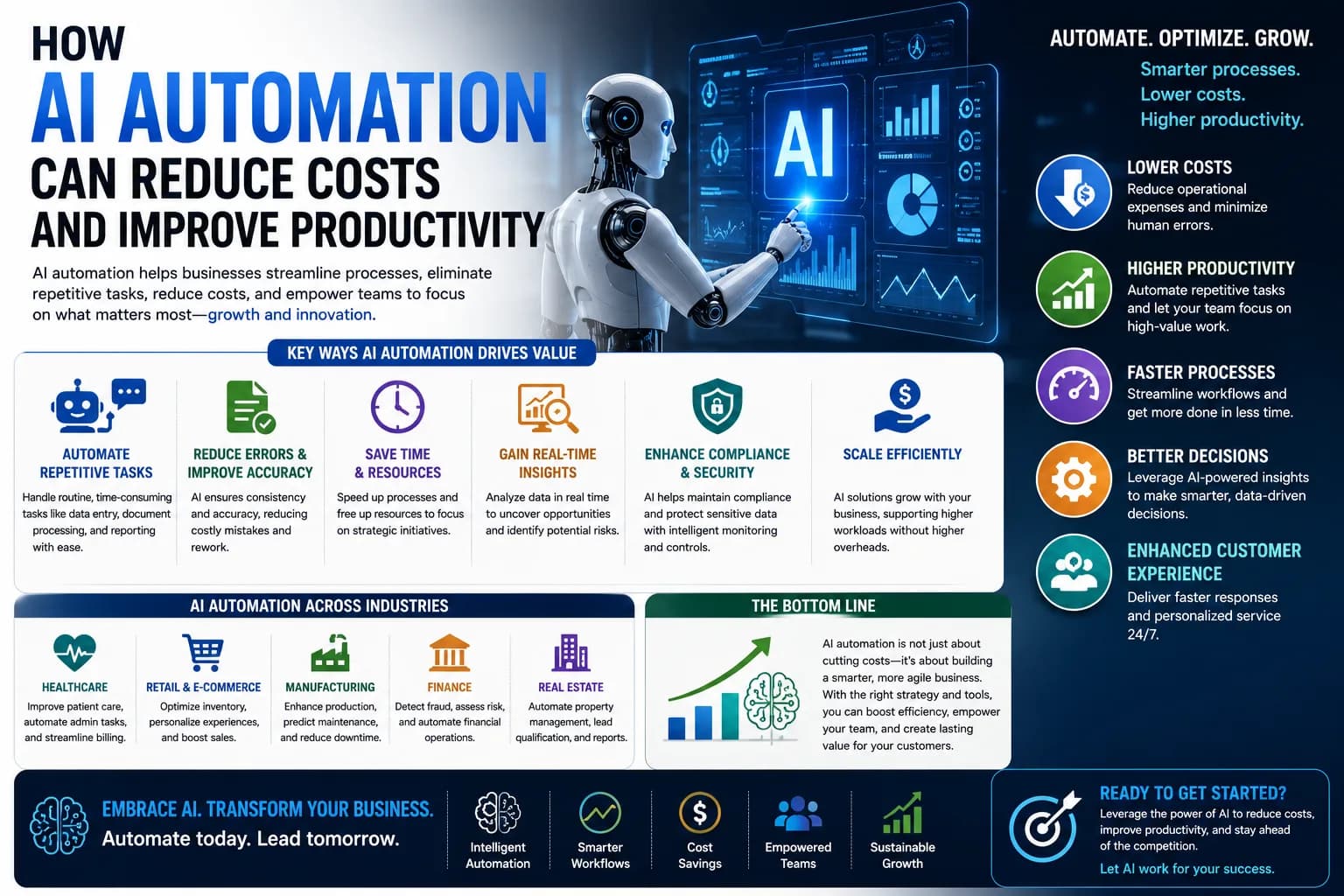
Artificial intelligence is rapidly changing the way businesses operate, helping organizations automate repetitive tasks, reduce operational costs, and improve productivity. As companies look for smarter ways to manage growing workloads and increasing customer expectations, artificial intelligence solutions have become an important part of modern business strategy.
AI automation allows businesses to use intelligent systems to handle routine processes, analyze large amounts of data, support decision-making, and improve customer experiences. From small businesses to large enterprises, organizations are using AI development services to create customized solutions that improve efficiency and support sustainable growth.
In 2026, adopting AI is no longer simply about keeping up with technology. It is becoming a strategic way for businesses to work faster, reduce unnecessary expenses, and create new opportunities.
What Is AI Automation?
AI automation combines artificial intelligence with automated business processes. Traditional automation follows predefined rules, while AI-powered automation can analyze information, identify patterns, learn from data, and make recommendations.
AI automation can be used for:
Customer service
Data processing
Document management
Financial operations
Marketing
Sales
Inventory management
Human resources
IT support
Business analytics
By automating repetitive activities, employees can focus on more valuable tasks that require creativity, communication, and strategic thinking.
How AI Automation Reduces Business Costs
One of the biggest advantages of AI automation is its ability to reduce operational expenses without compromising productivity.
1. Reduces Repetitive Manual Work
Employees often spend significant amounts of time performing repetitive activities such as entering data, processing documents, responding to common questions, and generating routine reports.
AI automation can handle many of these processes automatically.
For example, an AI-powered system can extract information from documents, categorize data, and transfer it into business applications without requiring employees to complete every step manually.
This reduces administrative workload and allows employees to focus on higher-value responsibilities.
2. Improves Employee Productivity
AI does not simply replace manual work—it can help employees work more effectively.
AI tools can assist teams by:
Summarizing information
Finding relevant data
Automating routine communications
Creating reports
Analyzing business information
Supporting decision-making
When employees spend less time on repetitive work, they have more time to focus on innovation, customer relationships, and strategic activities.
3. Minimizes Human Errors
Manual processes can result in mistakes, particularly when employees work with large volumes of data.
AI-powered systems can process information consistently and identify potential errors or unusual patterns.
This is particularly useful for:
Financial records
Inventory data
Customer information
Business reports
Document processing
Reducing errors can prevent unnecessary costs associated with corrections, delays, and inaccurate decisions.
4. Optimizes Business Operations
AI can analyze operational data to identify inefficiencies and recommend improvements.
Businesses can use AI to understand:
Where resources are being wasted
Which processes are taking too long
Where customer demand is changing
Which activities generate the greatest value
These insights help organizations make smarter decisions about their time, workforce, and resources.
How AI Automation Improves Productivity
Cost reduction is only one benefit of artificial intelligence. AI automation can also significantly improve business productivity.
Faster Decision-Making
AI can analyze large datasets much faster than manual processes. Businesses can receive insights quickly and respond to changing market conditions more effectively.
24/7 Availability
AI-powered systems can operate continuously without traditional working-hour limitations.
For example, AI chatbots can answer common customer questions outside normal business hours, helping businesses provide continuous support.
Faster Customer Service
AI can automatically classify customer requests, provide answers to frequently asked questions, and direct complex issues to the appropriate employees.
This reduces response times while allowing support teams to focus on more complicated customer needs.
Better Resource Allocation
AI can help managers determine where resources are needed most.
Predictive analytics can identify demand patterns, allowing businesses to optimize staffing, inventory, equipment, and other resources.
The Role of AI Development Services
Every business has different requirements, which is why customized technology can be more effective than generic solutions.
Professional AI development services help organizations design, develop, integrate, and maintain AI-powered applications based on their specific objectives.
Custom AI development may include:
AI-powered chatbots
Machine learning applications
Predictive analytics platforms
Recommendation systems
Intelligent document processing
Computer vision solutions
Natural language processing
Workflow automation
AI-powered business dashboards
A customized AI solution can integrate with existing business systems and automate processes that are unique to an organization.
AI Automation Across Different Industries
AI automation is transforming businesses across multiple sectors.
Healthcare
Healthcare and Medical Services organizations can use AI automation to improve administrative efficiency and support better patient experiences.
Potential applications include:
Appointment scheduling
Patient communication
Medical documentation support
Data analysis
Billing workflow automation
Patient record management
Predictive analytics
Healthcare organizations must implement AI carefully, with appropriate attention to privacy, security, compliance, and clinical oversight.
Retail
Retail businesses can use AI to improve inventory forecasting, customer recommendations, pricing analysis, and customer support.
Manufacturing
Manufacturers can implement AI for predictive maintenance, quality inspection, production planning, and supply chain optimization.
Finance
Financial organizations use AI for fraud detection, document processing, risk analysis, customer support, and financial forecasting.
Construction and Real Estate
AI can assist with project planning, demand forecasting, property analysis, document management, and customer engagement.
AI-Powered Customer Service
Customer expectations are continuously increasing. Businesses need to provide fast and personalized support while controlling service costs.
AI-powered customer service solutions can:
Answer frequently asked questions
Categorize support requests
Recommend relevant information
Assist customer service representatives
Analyze customer feedback
AI can handle routine interactions while human employees manage complex or sensitive situations.
AI and Predictive Analytics
One of the most valuable applications of AI is predictive analytics.
AI systems can analyze historical and real-time information to identify potential future trends.
Businesses can use predictive analytics for:
Sales forecasting
Customer behavior analysis
Demand planning
Risk management
Inventory optimization
Equipment maintenance
Better predictions allow companies to make proactive decisions instead of reacting after problems occur.
Important Considerations Before Implementing AI
Although AI offers significant benefits, businesses should implement it strategically.
Identify the Right Processes
Not every business process needs AI. Start with repetitive, time-consuming, or data-intensive tasks where automation can provide measurable value.
Protect Business Data
Organizations should establish appropriate security controls and data governance before implementing AI systems.
Train Employees
Employees should understand how AI tools work and how these technologies will support their responsibilities.
Measure Results
Businesses should track measurable outcomes such as:
Cost savings
Processing time
Productivity
Error rates
Customer satisfaction
Revenue impact
Measuring performance helps organizations determine whether an AI initiative is delivering the expected return on investment.
The Future of AI Automation
AI automation will continue becoming more intelligent and accessible. Businesses are increasingly moving toward AI-powered workflows where multiple systems can communicate, analyze information, and complete tasks with limited human intervention.
Future developments may include:
Autonomous business workflows
AI-powered decision support
Advanced predictive analytics
Intelligent virtual assistants
AI agents for business operations
Personalized customer experiences
Automated data analysis
Organizations that build a strong AI strategy today can establish a foundation for future innovation.
Conclusion
AI automation is transforming business operations by reducing repetitive work, minimizing errors, improving productivity, and helping organizations make better decisions. By adopting reliable artificial intelligence solutions, businesses can streamline workflows and use their resources more effectively.
Professional AI development services can take this further by creating customized solutions that align with specific business requirements and integrate with existing systems. From customer service and predictive analytics to workflow automation and data processing, AI can create measurable improvements across industries.
Businesses in sectors such as Healthcare and Medical Services, finance, retail, manufacturing, construction, and real estate can benefit from carefully implemented AI strategies.
If your organization is looking to reduce operational costs, automate repetitive processes, and improve productivity, Doddapaneni Group (Doddapanenigroup.net) can help you explore innovative AI, software, and digital transformation solutions designed around your business goals.