Introduction
Businesses in 2026 face increasing pressure to improve efficiency, reduce operational costs, and remain competitive in rapidly changing markets. Rising labor expenses, complex workflows, growing customer expectations, and expanding digital operations are forcing organizations to rethink traditional business processes.
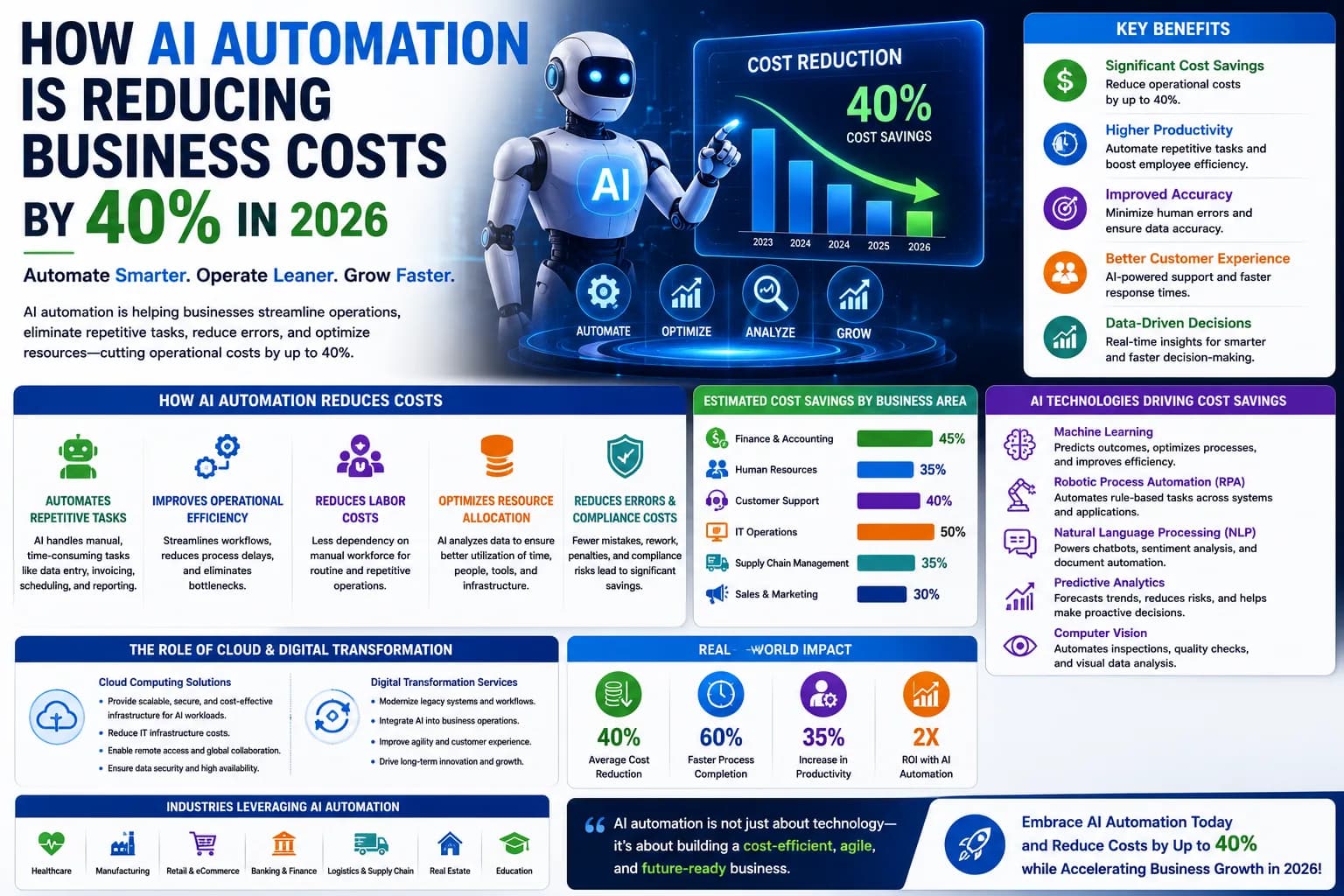
Artificial Intelligence (AI) automation has emerged as one of the most effective solutions for reducing operational expenses while improving productivity and customer satisfaction. Companies across industries are implementing AI-driven systems to automate repetitive tasks, streamline workflows, and optimize resource allocation.
Organizations investing in modern cloud computing solutions and advanced digital transformation services are reporting significant cost savings, improved operational efficiency, and faster business growth. In many cases, AI-powered automation is helping businesses reduce operational costs by up to 40% through intelligent process optimization.
Industries ranging from finance and retail to manufacturing and healthcare technology solutions are leveraging AI automation to transform how they operate and compete.
This guide explores how AI automation reduces business costs, the technologies driving this transformation, real-world applications, benefits, challenges, and future trends shaping the business landscape in 2026.
What Is AI Automation?
AI automation combines artificial intelligence technologies with automated workflows to perform tasks that traditionally required human intervention.
Unlike basic automation, AI systems can:
Learn from data
Recognize patterns
Make predictions
Adapt to changing conditions
Improve performance over time
AI automation helps businesses work smarter rather than harder.
Why Businesses Are Investing in AI Automation
Modern organizations generate enormous amounts of data and manage increasingly complex operations.
Key Business Challenges Include:
Rising operational expenses
Labor shortages
Human errors
Slow decision-making
Customer service demands
AI automation addresses these challenges by improving efficiency and reducing manual workloads.
How AI Automation Reduces Business Costs
Automating Repetitive Tasks
Many organizations spend thousands of hours on repetitive administrative activities.
Examples Include:
Data entry
Invoice processing
Appointment scheduling
Payroll management
Inventory updates
AI-powered automation completes these tasks faster and with fewer errors.
Cost Reduction Impact:
Reduced labor costs
Increased productivity
Lower administrative expenses
Improving Employee Productivity
AI allows employees to focus on higher-value work instead of routine activities.
Benefits Include:
Faster task completion
Better decision-making
Increased innovation
Improved job satisfaction
Higher productivity translates directly into lower operational costs.
Reducing Human Errors
Manual processes often lead to:
Billing mistakes
Data inaccuracies
Compliance violations
Inventory discrepancies
AI systems maintain consistency and accuracy across business operations.
Result:
Reduced financial losses and improved operational reliability.
Optimizing Resource Allocation
AI analyzes historical and real-time data to optimize:
Workforce scheduling
Equipment usage
Supply chain operations
Inventory management
Smarter resource utilization reduces waste and unnecessary expenses.
Enhancing Customer Service
AI-powered chatbots and virtual assistants provide 24/7 customer support.
Customer Service Benefits:
Faster response times
Reduced support costs
Improved customer satisfaction
Increased scalability
Businesses can serve more customers without significantly increasing staffing costs.
Role of Cloud Computing Solutions in AI Automation
Modern cloud computing solutions provide the infrastructure needed to deploy and scale AI technologies efficiently.
Benefits of Cloud-Based AI Systems
Scalability
Businesses can expand AI capabilities without major hardware investments.
Cost Efficiency
Cloud platforms eliminate large upfront infrastructure costs.
Accessibility
Employees can access AI-powered systems from anywhere.
Security
Cloud providers offer advanced security and backup systems.
Cloud computing enables businesses to implement AI automation quickly and affordably.
Digital Transformation Services and Cost Optimization
Successful AI implementation often requires broader organizational change.
This is where digital transformation services play a critical role.
Digital Transformation Includes:
Process modernization
Cloud migration
Workflow automation
Data integration
Technology adoption strategies
Organizations that embrace digital transformation achieve higher operational efficiency and long-term cost savings.
AI Automation Across Different Business Functions
Finance and Accounting
AI automates:
Invoice processing
Expense tracking
Financial reporting
Fraud detection
Benefits:
Reduced accounting costs
Improved accuracy
Faster financial operations
Human Resources
AI assists with:
Resume screening
Employee onboarding
Workforce analytics
Performance management
HR departments save significant time and resources.
Sales and Marketing
AI improves:
Lead generation
Customer segmentation
Campaign optimization
Sales forecasting
Businesses achieve better marketing ROI with lower acquisition costs.
Supply Chain Management
AI helps optimize:
Inventory forecasting
Logistics planning
Procurement processes
Demand prediction
Supply chain efficiency directly impacts profitability.
AI Automation in Healthcare Technology Solutions
The healthcare sector is experiencing major transformation through AI-driven automation.
Organizations implementing healthcare technology solutions use AI for:
Administrative Automation
Appointment scheduling
Medical billing
Insurance verification
Clinical Support
Diagnostic assistance
Patient monitoring
Treatment recommendations
Operational Management
Resource planning
Healthcare analytics
Workflow optimization
AI helps healthcare providers reduce costs while improving patient outcomes.
Real-World Areas Where Businesses Save Money
Customer Support Automation
AI chatbots reduce customer service staffing requirements while maintaining service quality.
Predictive Maintenance
AI identifies equipment issues before failures occur.
Benefits:
Reduced downtime
Lower repair costs
Extended equipment lifespan
Inventory Optimization
AI predicts demand more accurately.
Results:
Reduced excess inventory
Lower storage costs
Improved cash flow
Fraud Detection
AI identifies suspicious activities quickly.
Benefits:
Reduced financial losses
Better compliance
Improved risk management
Emerging AI Automation Trends in 2026
Generative AI Integration
Businesses are using AI to generate:
Content
Reports
Marketing materials
Business insights
Hyperautomation
Organizations are combining:
AI
Robotic Process Automation (RPA)
Machine Learning
Workflow Automation
This creates fully automated business ecosystems.
AI-Powered Decision Intelligence
Advanced systems help leaders make data-driven decisions faster.
Autonomous Operations
Businesses are increasingly automating entire operational processes with minimal human involvement.
Challenges of AI Automation
While AI offers significant benefits, businesses must address several challenges.
Implementation Costs
Initial investments may include:
Software licensing
Integration costs
Employee training
However, long-term savings often outweigh these expenses.
Data Quality Issues
AI systems require accurate and reliable data for optimal performance.
Change Management
Employees may need support adapting to new technologies and workflows.
Cybersecurity Risks
AI systems must be protected from:
Data breaches
Unauthorized access
Cyberattacks
Strong security measures are essential.
Best Practices for Successful AI Automation
Identify High-Impact Processes
Focus on repetitive and resource-intensive tasks first.
Invest in Scalable Technology
Choose solutions that can grow with business needs.
Leverage Cloud Infrastructure
Modern cloud computing solutions provide flexibility and scalability.
Develop a Digital Transformation Roadmap
Strategic digital transformation services help ensure successful implementation.
Monitor Performance Continuously
Track:
Cost savings
Productivity improvements
Customer satisfaction
Operational efficiency
Continuous optimization maximizes AI benefits.
Future of AI Automation
The future of AI automation will focus on:
Autonomous business operations
Predictive analytics
Intelligent customer experiences
AI-driven decision-making
Fully connected digital ecosystems
Organizations adopting AI today will be better positioned to compete in tomorrow’s economy.
FAQs
Q1: Can AI automation really reduce business costs by 40%?
Many organizations achieve significant cost reductions by automating repetitive tasks, improving productivity, and optimizing resources.
Q2: Why are cloud computing solutions important for AI?
Cloud infrastructure provides scalable, secure, and cost-effective environments for deploying AI systems.
Q3: What are digital transformation services?
They help businesses modernize operations, adopt technology, and improve efficiency through digital innovation.
Q4: How do healthcare technology solutions benefit from AI?
AI improves healthcare administration, diagnostics, patient management, and operational efficiency.
Conclusion
AI automation is transforming businesses in 2026 by reducing operational expenses, improving productivity, and enabling smarter decision-making. Companies investing in modern cloud computing solutions and strategic digital transformation services are achieving substantial cost savings while building scalable and future-ready operations.
Industries across the globe—including organizations deploying advanced healthcare technology solutions—are leveraging AI automation to streamline workflows, improve customer experiences, and maintain a competitive advantage.
DoddapaneniGroup.net provides AI development, cloud computing, software engineering, digital transformation, and business automation solutions designed to help organizations reduce costs, improve efficiency, and accelerate growth in the digital era.
Disclaimer: This content is for informational purposes only and should not be considered financial, legal, or technology implementation advice.